Showing posts with label svetlana boym. Show all posts

Wednesday, 24 November 2010

Reflective Nostalgia


^Sphinx, by M.Shemyakin, St Petersburg source

The second excerpt from Svetlana Boym's "The future of Nostalgia". The first here.


Reflective Nostalgia: Virtual Reality and Collective Memory

"Restoration (from re-staure –re-establishment) signifies a return to the original stasis, to the prelapsarian moment. The past for the restorative nostalgic is a value for the present; the past is not a duration but a perfect snapshot. Moreover the past is not supposed to reveal any signs of decay; it has to be freshly painted in its “original image” and remain eternally young. Reflective nostalgia is more concerned with historical and individual time, with the irrevocability of the past and human finitude. Re-flection suggests new flexibility, not the reestablishment of stasis. The focus here is not on recovery of what is perceived to be an absolute truth but on the mediation on history and passage of time. To paraphrase Nabokov, these kind of nostalgics are often “amateurs of time, epicures of duration,” who resist the pressure of external efficiency and take sensual delight in the texture of time not measurable by clocks and calendars.

Restorative nostalgia evoke national past and future; reflective nostalgia is more about individual and cultural memory. The two might overlap in their frames of reference, but they do not coincide in their narratives and plots of identity. In other words, they can use the same triggers of memory and symbols, the same Proustian madeleine pastry, but tell different stories about it.

Nostalgia of the first type gravitates toward collective pictorial symbols and oral culture. Nostalgia of the second type is more oriented toward an individual narrative that savours details and memorial signs, perpetually deferring homecoming itself. If restorative nostalgia ends up reconstructing emblems and rituals of home and homeland in an attempt to conquer and spatialize time, reflective nostalgia cherishes shattered fragments of memory and temporalizes space. Restorative nostalgia takes itself deadly seriously. Reflective nostalgia, on the other hand, can be ironic and humorous. It reveals that longing and critical thinking are not opposed to one another, as affective memories do not absolve one from compassion, judgement or critical reflection.

Reflective nostalgia does not pretend to rebuild the mythical place called home; it is “enamoured of distance, not of the referent itself.” This type of nostalgic narrative is ironic, inclusive and fragmentary. Nostalgics of the second type are aware of the gap between identity and resemblance; the home is in ruins or, on the contrary, has been just renovated and gentrified beyond recognition. This de-familiarisation and sense of distance drives them to tell their story, to narrate the relationship between past, present and future. Through such longing these nostalgics discover that the past is not merely that which doesn’t exist anymore, but, to quote Henri Bergson, the past “might act and will act by inserting itself into a present sensation from which it borrows the vitality.” The past is not made in the image of the present or seen as foreboding of some present disaster; rather, the past opens up a multitude of potentialities, non-teleological possibilities of historic development. We don’t need a computer to get access to the virtualities of our imagination: reflective nostalgia has a capacity to awaken multiple planes of consciousness.


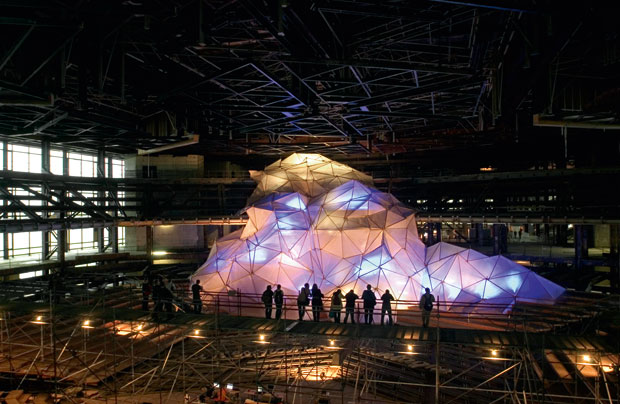
^ "Der Berg" installation in the Palast Der Republik, Berlin, two years before its demolition to make way for a reconstructed Palace that was on the site prior to WWII source

The virtual reality of consciousness, as defined by Henri Bergson, is a modern concept, yet it does not rely on technology; on the contrary, it is about human freedom and creativity. According to Bergson, the human creativity, élan vital, that resists mechanical repetition and predictability, allows us to explore the virtual realities of consciousness. For Marcel Proust, remembrance is an unpredictable adventure in syncretic perception where words and tactile sensations overlap. Place names open up mental maps and space folds into time. “The memory of a particular image is but regret for a particular moment;  and houses, roads, avenues are as fugitive, alas, as the years,” writes Proust at the end of Swann’s Way. What matters then, is the memorable literary fugue, not the actual return home.

The modern nostalgic realises that “the goal of the odyssey is a rendezvous with oneself.” For Jorge Luis Borges, for instance, Ulysses returns home only to look back at his journey. In the alcove of his fair queen he becomes nostalgic for his nomadic self: “Where is that man who in the days and nights of exile erred around the world like a dog and said that Nobody was his name?” Homecoming does not signify a recovery of identity; it does not end the journey in the virtual space of imagination. A modern nostalgic can be homesick and sick of home, at once.

As most of the stories in this book suggest, the nostalgic rendezvous with oneself is not always a private affair. Voluntary and involuntary recollections of an individual intertwine with collective memories. In many cases the mirror of reflective nostalgia is shattered by experiences of collective devastation and resembles –involuntarily- a modern work of art. Bosnian poet Semezdin Mehmedinovic offers one of such shattered mirrors from his native Sarajevo:

“Standing by the window, I see the shattered glass of Yugobank. I could stand like this for hours. A blue, glassed-in façade. One floor above the window I am looking from, a professor of aesthetics comes out onto his balcony; running his fingers through his beard, he adjusts his glasses. I see his reflection in the blue façade of Yugobank, in the shattered glass that turns the scene into a live cubist painting on a sunny day.”"

Monday, 22 November 2010

Restorative Nostalgia

^Reconstructed Cathedral of Christ Our Saviour, Moscow source

The first excerpt of two laying out the two entirely incomensurable and often confused forms in which contemporary nostalgia manifests itself -Restorative and Reflective- the one dangerous and easily abused, unconscious and easy to accept, the other profoundly complex, personal and requiring active contemplation and engagement, and ultimately hugely rewarding. Both extracts are from Svetlana Boym's deeply inspiring and thorough book "The Future of Nostalgia", in which she takes Nostalgia as an intrinsic and inescapable condition of moderinty, set only to increase in potency in the years to come, and sets about breaking it down into its component parts, its various appearances, sinister and beautiful, and states the case for positively engaging with it as a key to understanding and in a way, enjoying, our fantastically unstable 21st century Human Condition. It was my best read since, and the best possible Architect's addendum to "In Search Of Lost Time", and was also strangely similar, but far more precise and ambitious than Nicolas Bourriaud's The Radicant, in which Bourriaud posits an artistic form of  nomadic rootlessness, in which artists engage in creating their own micro-narratives of belonging in a life-long, international trajectory, positing the artistic project as one of a perpetualy Reflective, and transformational Nostalgia.

.........................................................................................

Restorative Nostalgia: Conspiracies and Return To Origins

"Two kinds of nostalgia are not absolute types, but rather tendencies, ways of giving shape and meaning to longing. Restorative nostalgia puts emphasis on nostos (returning home)and proposes to rebuild the lost home and patch up the memory gaps. Reflective nostalgia dwells in algia (aching), in longing and loss, the imperfect process of remembrance. The first category of nostalgics do not think of themselves as nostalgic; they believe that their project is about truth. This kind of nostalgic characterizes national and nationalist revivals all over the world, which engage in the anti-modern myth-making of history by means of a return to nationalist symbols and myths and, occasionally, through swapping conspiracy theories. Restorative nostalgia manifests itself in total reconstructions of monuments from the past, while reflective nostalgia lingers on ruins, the patina of time and history, in the dreams of another place and another time.

To understand restorative nostalgia it is important to distinguish between the habits of the past and the habits of the restoration of the past. Eric Hobsbawn differentiates between age old “customs” and nineteenth century “invented traditions”. Customs by which so-called traditional societies operated were not invariable or inherently conservative: “Custom in traditional societies has a double function of motor and fly wheel… Custom cannot afford to be invariant because even in the traditional societies life is not so.”
On the other hand, restored or invented tradition refers to a “set of practices normally governed by overtly or tacitly accepted rules and a ritual of symbolic nature which seeks to inculcate certain values and norms of behaviour by repetition which automatically implies continuity with the past.” The new traditions are characterized by a higher degree of symbolic formalization and ritualization than the actual peasant customs and conventions after which they were patterned. Here are two paradoxes. First, the more rapid and sweeping the pace and scale of modernization, the more conservative and unchangeable the new traditions tend to be, Second, the stronger the rhetoric of continuity with the historical past and emphasis on traditional values, the more selectively the past is presented. The novelty of invented tradition is “no less novel for being able to dress up easily as antiquity”.

Invented tradition does not mean a creation ex nihilo or a pure act of social constructivism; rather, it builds on the sense of loss of community and cohesion and offers a comforting collective script for individual longing. There is a perception that as a result of society’s industrialization and secularization in the nineteenth century, a certain void of social and spiritual meaning has opened up. What was needed was a secular transformation of fatality into continuity, contingency into meaning. Yet this transformation can take different turns. It may increase the emancipatory possibilities and individual choices, offering multiple imagined communities and ways of belongingthat are not exclusivelybased on ethnic or national principles. It can also be politically manipulated through newly recreated practices of national commemoration with the aim of re-establishing social cohesion, a sense of security and an obedient relationship to authority.

Cultural identity is based on a certain social poetics or “cultural intimacy” that provides a glue in everyday life. This was described by anthropologist Michael Herzfeld as “embarrassment and rueful self-recognition” through various common frameworks of memory and even what may appear as stereotypes. Such identity involves everyday games of hide-and-seek that only “natives” play, unwritten rules of behaviour, jokes understood from half a word, a sense of complicity. State propaganda and official national memory build on this cultural intimacy, but there is also a discrepancy and tension between the two. It is very important to distinguish between political nationalism and cultural intimacy, which, after all, is based on common social context, not on national or ethnic homogeneity.

^93metre high statue of Peter The Great in the Moskva River, built 1997 source
National memory reduces this space of play with memorial signs to a single plot. Restorative nostalgia knows two main narrative plots –the restoration of origins and the conspiracy theory, characteristic of the most extreme cases of contemporary nationalism fed on right-wing popular culture. The conspiratorial worldview reflects a nostalgia for a transcendental cosmology and a simple pre-modern conception of good and evil. The conspiratorial worldview is based on a single trans-historical plot, a Manichean battle of good and evil and the inevitable scapegoating of the mythical enemy. Ambivalence, the complexity of history and the specificity of modern circumstances is thus erased, and modern history is seen as a fulfilment of ancient prophecy. “Home”, imagine extremist conspiracy theory adherents, is forever under siege, requiring defence against the plotting enemy.

[...] Nostalgia is an ache of temporal distance and displacement. Restorative nostalgia takes care of both these symptoms. Distance is compensated by intimate experience and the availability of a desired object. Displacement is cured by a return home, preferably a collective one. Never mind if it’s not your home; by the time you reach it, you will have already forgotten the difference. What drives restorative nostalgia is not the sentiment of distance and longing but rather the anxiety about those who draw attention to historical incongruities between past and present and thus question the wholeness and continuity of the restored tradition.

Even in its less extreme form, restorative nostalgia has no use for the signs of historical time –patina, ruins, cracks, imperfections. The 1980s and 1990s was a time of great revival of the past in several projects of total restoration –from the Sistine Chapel to the Cathedral of Christ the Saviour in Moscow- that attempted to restore a sense of the sacred believed to be missing from the modern word."