^Sphinx, by M.Shemyakin, St Petersburg source
The second excerpt from Svetlana Boym's "The future of Nostalgia". The first
here.
Reflective Nostalgia: Virtual Reality and Collective Memory
"Restoration (from re-staure –re-establishment) signifies a return to the original stasis, to the prelapsarian moment. The past for the restorative nostalgic is a value for the present; the past is not a duration but a perfect snapshot. Moreover the past is not supposed to reveal any signs of decay; it has to be freshly painted in its “original image” and remain eternally young. Reflective nostalgia is more concerned with historical and individual time, with the irrevocability of the past and human finitude. Re-flection suggests new flexibility, not the reestablishment of stasis. The focus here is not on recovery of what is perceived to be an absolute truth but on the mediation on history and passage of time. To paraphrase Nabokov, these kind of nostalgics are often “amateurs of time, epicures of duration,” who resist the pressure of external efficiency and take sensual delight in the texture of time not measurable by clocks and calendars.
Restorative nostalgia evoke national past and future; reflective nostalgia is more about individual and cultural memory. The two might overlap in their frames of reference, but they do not coincide in their narratives and plots of identity. In other words, they can use the same triggers of memory and symbols, the same Proustian madeleine pastry, but tell different stories about it.
Nostalgia of the first type gravitates toward collective pictorial symbols and oral culture. Nostalgia of the second type is more oriented toward an individual narrative that savours details and memorial signs, perpetually deferring homecoming itself. If restorative nostalgia ends up reconstructing emblems and rituals of home and homeland in an attempt to conquer and spatialize time, reflective nostalgia cherishes shattered fragments of memory and temporalizes space. Restorative nostalgia takes itself deadly seriously. Reflective nostalgia, on the other hand, can be ironic and humorous. It reveals that longing and critical thinking are not opposed to one another, as affective memories do not absolve one from compassion, judgement or critical reflection.
Reflective nostalgia does not pretend to rebuild the mythical place called home; it is “enamoured of distance, not of the referent itself.” This type of nostalgic narrative is ironic, inclusive and fragmentary. Nostalgics of the second type are aware of the gap between identity and resemblance; the home is in ruins or, on the contrary, has been just renovated and gentrified beyond recognition. This de-familiarisation and sense of distance drives them to tell their story, to narrate the relationship between past, present and future. Through such longing these nostalgics discover that the past is not merely that which doesn’t exist anymore, but, to quote Henri Bergson, the past “might act and will act by inserting itself into a present sensation from which it borrows the vitality.” The past is not made in the image of the present or seen as foreboding of some present disaster; rather, the past opens up a multitude of potentialities, non-teleological possibilities of historic development. We don’t need a computer to get access to the virtualities of our imagination: reflective nostalgia has a capacity to awaken multiple planes of consciousness.

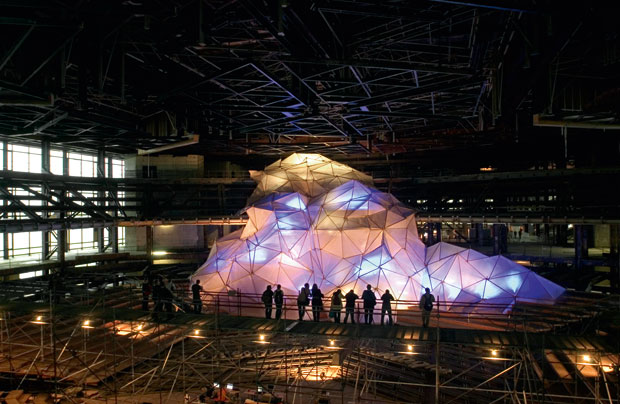
^ "Der Berg" installation in the Palast Der Republik, Berlin, two years before its demolition to make way for a reconstructed Palace that was on the site prior to WWII source
The virtual reality of consciousness, as defined by Henri Bergson, is a modern concept, yet it does not rely on technology; on the contrary, it is about human freedom and creativity. According to Bergson, the human creativity, élan vital, that resists mechanical repetition and predictability, allows us to explore the virtual realities of consciousness. For Marcel Proust, remembrance is an unpredictable adventure in syncretic perception where words and tactile sensations overlap. Place names open up mental maps and space folds into time. “The memory of a particular image is but regret for a particular moment; and houses, roads, avenues are as fugitive, alas, as the years,” writes Proust at the end of Swann’s Way. What matters then, is the memorable literary fugue, not the actual return home.
The modern nostalgic realises that “the goal of the odyssey is a rendezvous with oneself.” For Jorge Luis Borges, for instance, Ulysses returns home only to look back at his journey. In the alcove of his fair queen he becomes nostalgic for his nomadic self: “Where is that man who in the days and nights of exile erred around the world like a dog and said that Nobody was his name?” Homecoming does not signify a recovery of identity; it does not end the journey in the virtual space of imagination. A modern nostalgic can be homesick and sick of home, at once.
As most of the stories in this book suggest, the nostalgic rendezvous with oneself is not always a private affair. Voluntary and involuntary recollections of an individual intertwine with collective memories. In many cases the mirror of reflective nostalgia is shattered by experiences of collective devastation and resembles –involuntarily- a modern work of art. Bosnian poet Semezdin Mehmedinovic offers one of such shattered mirrors from his native Sarajevo:
“Standing by the window, I see the shattered glass of Yugobank. I could stand like this for hours. A blue, glassed-in façade. One floor above the window I am looking from, a professor of aesthetics comes out onto his balcony; running his fingers through his beard, he adjusts his glasses. I see his reflection in the blue façade of Yugobank, in the shattered glass that turns the scene into a live cubist painting on a sunny day.”"