Showing posts with label extracts. Show all posts

Wednesday, 8 January 2014

Taste, Style and Loos

^Il Bagno Blu in D'annunzio's Vittoriale. An extreme illustration of the points below.

Two extracts from the collection of translated essays by Loos "Creating Your Home With Style" that summarise in the most unadulterated form I could find his stance on the relationship between the inhabitants of a space, their evolution as human beings over time, the design of that space's interior and the disposition and gradual accumulation of objects and furniture within it governed by the interaction of those various agents. It is the only view I could conform to entirely in the collection, and whilst it was repeated in various guises elsewhere, it tended to get mixed up in strange ways with his fear of dirt, with his Anglophilia, hatred of ornament and his utter terror of freestanding cupboards, amongst other very odd things. This is followed by a small statement on the circularity of fashion as being at its core a primer for finding pleasure in things once loved, which given a certain period of time away from our gaze -with a drizzle of scorn- can once again be enjoyed... ad infinitum.

The painters however were right. They who, thanks to their training and experience, have a much sharper eye for all outward appearances, have always been able to recognize the superficial, pretentious, the alien, unharmonious nature of our “stylish” apartments. The people do not fit in with these rooms, nor do the rooms with the people. But how could they? The architect or the interior designer hardly even knows the name of the person for whom he is working. Even if the person has paid for the room 100-fold, they are still not his rooms. They always will remain the intellectual & spiritual property of the person who created them. That is why they do not, simply cannot appeal to the painter. They lack all intimacy and personal connection with the people who live in them. They lack that unique personal touch that he finds in the room of the simple peasant, the poor labourer, or the old spinster.

I did not, thank God, grow up in such a “stylish” apartment. It was just not possible at that time. Now, sadly, things have changed in my family as well. But in those days… Our table for instance, was a crazy jumble of wood adorned with some dreadful metal ornaments. But it was our table, our table! Can you imagine what that meant? Can you imagine the countless joyful hours that we spent at it –by the lamplight? In the evening when I was a little boy I could just not tear myself away from it, and my father had to imitate the night watchman’s horn to make me scuttle off in fright to the nursery. Then there was the desk, and on it the ink spot, where my sister Hermine had spilled ink on it when she was a tiny baby. And the pictures of my parents –what awful frames! But they were a wedding present from my father’s employees. And this old-fashioned chair here, a left-over from my grandmother’s home. And here a knitted slipper in which you can hang the clock, made in kindergarten by sister Irma. Every piece of furniture, every object, every thing had a story to tell –the story of our family. During the period in which the pressure to furnish one’s home in “style” became greater and greater –when all one’s acquaintances had “Old German” rooms, how could one simply refuse to adapt? So, all the old junk was thrown out. It might be junk for anyone else, but revered relics for the family. The rest was left up to the upholsterer.

Now we have had enough. We want to be masters of our own four walls again. If we lack taste, that’s fine, then we will furnish our homes in a taste-less manner. If we have good taste, all the better. But we refuse to be tyrannized by our own rooms any longer. We will buy everything we feel that we need and what appeals to us.

What appeals to us! That is the style that we have been seeking for so long, the style we wanted to bring into our apartments. The style that does not depend on all-pervading lion’s heads, but on taste –or, perhaps the lack of it- of an individual or family, things that comply with their sense of well-being. This sense would be underscored by the fact that the owner had selected all these objects & pieces of furniture in a room. And even if he were to prove to be somewhat capricious, especially regarding the choice of colours, it still would not be a disaster. A home that has grown along with the family can put up with quite a lot. Putting just one single ornament that does not belong into one of the “stylish” rooms can ruin the whole “effect”. In a “family” room it would immediately be absorbed into the whole. Such a room is somewhat like a violin: just as a violin is broken in by repeatedly playing it, a room can be “broken in” by living in it.

[]

Taste and the desire for change have always been closely linked. Today we wear narrow trousers; tomorrow they will be wide, and the day after narrow again. Every tailor knows this. Well then, couldn’t we just forgo the wide trouser period? Heavens no! We need it in order to enjoy our narrow trousers again. Just as we need a period of simple rooms for festive occasions in order to prepare us for the return of lavishly decorated ones.


Monday, 7 May 2012

Polis


^Lawrence Alma-Tadema, Phidias Showing the Frieze of the Parthenon to his Friends
Two extracts relating to the City (polis) from Hannah Arendt's The Human Condition, in which she explains how Greeks saw the built fabric -as they saw the structures of the law- as a clearly subservient, enabling framework whose entire reason for existence was exhausted in creating and then protecting the space in which political action, debate, oration, and discussion could occur, spectacularly, notably. The builders and craftsmen who dealt with putting up projects with definable outcomes, forms, and predictable lifespans, men who cut stone, layed-out the buildings on the agora, honed the acoustics in Greek theatres, penned the statute books and wrote down the legal structures of Democracy, these were the hard working but not heroic figures, who were there to build (for the first time in history) a world that was perfectly calibrated and designed for the active citizen-individual to show himself, doing, proposing, initiating, and acting in the public eye. They were backstage craft-caretakers of an environment where each person could be sure that the most highly valued, but most ephemeral of all things a man can bring into the world, namely the heroic act, the split second shining-forth of world-changing agency, the unrepeatable spark of transcendence, was not only given an audience in a built world calibrated for its maximum amplification, but that the built world would also act as its permanent embodiment, an assurance in stone that the intangible and endlessly precious chain of Human acts that make a polis would remain a story perpetually told. The city Homer.

“An outstanding symptom of this prevailing influence is that the Greeks, in distinction from all later developments, did not count legislating among the political activities. In their opinion, the lawmaker was like the builder of the city wall, someone who had to do and finish his work before political activity could begin. He therefore was treated like any other craftsman or architect and could be called from abroad and commissioned without having to be a citizen, whereas the right to be politeuesthai, to engage in the numerous activities which eventually went on in the polis, was entirely restricted to citizens. To them, the laws, like the wall around the city, were not results of action but products of making. Before men began to act, a definite space had to be secured and a structure built where all subsequent actions could take place, the space being the public realm of the polis and its structure the law; legislator and architect belonged in the same category. But these tangible entities themselves were not the content of politics (not Athens, but the Athenians were the polis), and they did not command the same loyalty we know from the Roman type of patriotism.”

“The polis –if we trust the famous words of Pericles in the Funeral Oration- gives a guaranty that those who forced every sea and land to become the scene of their daring will not remain without witness and will need neither Homer nor anyone else who knows how to turn words to praise them; without assistance from others, those who acted will be able to establish together the everlasting remembrance of their good and bad deeds, to inspire admiration in the present and future ages. In other words, men’s life together in the form of the polis seemed to assure that the most futile of human activities, action and speech, and the least tangible and most ephemeral of man-made “products”, the deeds and stories which are their outcome, would become imperishable. The organization of the polis, physically secured by the wall around the city and physiognomically guaranteed by its laws –lest the succeeding generations change its identity beyond recognition- is a kind of organized remembrance. It assures the mortal actor that his passing existence and fleeting greatness will never lack the reality that comes from being seen, being heard, and, generally, appearing before an audience of fellow men, who outside the polis could attend only the short duration of the performance and therefore needed Homer and “others of his craft” in order to be presented to those who were not there.”

Tuesday, 19 April 2011

RELICS


RELICS by Marcel Proust

"I have bought up all of her belongings that were put on sale -that woman whose friend I would like to have been, and who did not even condescend to talk to me for a few minutes. I have the little card game that kept her amused every evening, her two marmosets, three novels that bear her coat of arms on their boards, and her bitch. Oh, you delights and dear playthings of her life, you had access -without enjoying them as I would have done, and without even desiring them- to all her freest, most inviolable, and most secret hours; you were unaware of your happiness and you cannot describe it.

Cards that she would hold in her fingers every evening with her favourite friend who saw her getting bored or breaking into laughter, who were witnesses to the start of her liaison, and whom she threw down to fling her arms round the man who thereafter came every evening to enjoy a game with her; novels that she would open and close in her bed, as her fancy or her fatigue bade her, chosen by her on impulse or as her dreams dictated, books to which she confided her dreams and combined them with dreams expressed by the books that helped her better to dream for herself -did you retain nothing of her, and can you tell me nothing about her?

Novels; she dreamt in turn the lives of your characters and of your authors; and playing cards, for in her own way she enjoyed in your company the tranquillity and sometimes the feverishness of intimate friendships -did you keep nothing of her thoughts, which you distracted or filled, or of her heart, which you wounded or consoled?

Cards, novels, you were so often in her hands, or remained for so long on her table; queens, kings or knaves, who were the still guests at her wildest parties; heroes of novels and heroines who, at her bedside, caught in the cross-beam of her lamp and her eyes, dreamt your silent dream, a dream that was nonetheless filled with voices: you cannot have simply let it evaporate -all the perfume with which the air of her bedroom, the fabric of her dresses, and the touch of her hands or her knees imbued you.

You have preserved the creases left when her joyful or nervous hand crumpled you; you perhaps still keep prisoner those tears which she shed, on reading of a grief narrated in some book, or experienced in life; the day which made her eyes shine with joy or sorrow left its warm hues on you. When I touch you, I shiver, anxiously awaiting your revelations, disquieted by your silence. Alas! Perhaps, like you, charming and fragile creatures, she was the insensible and unconscious witness of her own grace. Her most real beauty existed perhaps in my desire. She lived her life, but perhaps I was the only one to dream it."


extract from NOSTALGIA by Marcel Proust

"Desire makes all things blossom, and possession makes them wither away."

Wednesday, 9 March 2011

Roll Over & Differentiate My Data Sets Baby.....................................................Patrick Schumacher & Some Old School AA-Speak

^annotation in personal copy of LOG21 by blog author


This is not something I am dogmatically imposing, I’m just observing that I, my friends, my students, naturally adhere to these principles without fail. Their hand would fall off rather than draw straight lines. Is anybody here drawing a triangle, a square, or a circle? Ever again? No!

you will always work with laws, with rule-based systems of differentiation. These can be applied meaningfully, for instance, in the adaptation of facades to create an intelligent differentiation of elements. You can do this by taking data sets like sun exposure maps and make them drive an intelligent differentiation of brise-soleil elements, which are scripted off the data set. But you can also apply this sort of technique to urbanism. We’re talking about urban fields, about the lawful differentiation of an urban fabric according to relevant data sets.”!

You can always identify where the rigid forms still persist, where there is still too much simple repetition, where there are still unrelated elements. You can always ask for further softening, further differentiation, and further correlation of everything with everything else. There’s always more to script and correlate to intensify the internal consistency and cross-connections and resonance within a project and to a context. It’s a never-ending trajectory of a project’s progression. The intensification of relations in architecture reflects the intensification of communication among all of us, everyday and with everything.

Extracts from "Parametricism And the Autopoiesis Of Architecture" by Patrick Schumacher in the winter 2011, 21st edition of Log magazine, published by AnyoneCorporation, & edited by Cynthia Davidson

Sunday, 6 March 2011

Frivolous & Serious Play

^drawing of Wonderwall, New Orleans, 1982-1984 (dismantled)

Extract from Charles W Moore's essay "The Yin, The Yang, and The Three Bears"

"Buildings, I have insisted for a long time, can and must speak to us, which requires that we grant them freedom of speech, the chance to say things that are unimportant, even silly, so when they are grave or portentous we can tell the difference. I have taken it as my particular mission to emphasise the light and sunny moments. I’m calling some of my projects Frivolous and Serious Play; I think the two are not inimical, and that both can be joyous."


^Wonderwall, New Orleans, 1982-1984 (dismantled)

Thursday, 18 November 2010

A Little Person Up There In The Crane


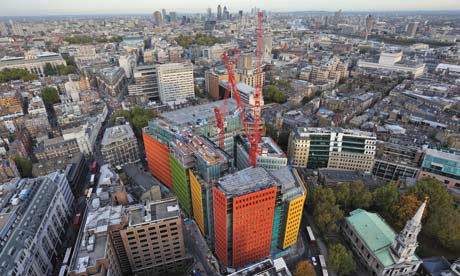
Over the past decade I’ve been living around more than my fair share of large construction sites, and I’ve enjoyed their cranes' sudden appearances, their elegant slow movements for a couple of years, and then their equally sudden disappearances as the hoardings come down around the brand spanking new building they helped to construct. The way they hover delicately over the weighty assemblage of static material below them, engaged on tight sites in a slow, precise and controlled choreography in the sky above the building so as to deliver bundles of material without knocking into each other, somehow without being swayed too far by the wind, and without damaging anything, or anyone below. And up there in the little cabs, like the minute brains of a stick insect, are the crane operators, heroic and alone, who I only ever saw as the sites would shut operations for the day, and probably in response to an alarm in their cabs, or a call on the mic, the cranes would come to a halt, frozen in position, and they would all descend simultaneously from their cabs, level by level down ladders on the insides of the cranes’ far too slimly proportioned structure, taking breaks at the same landings on their way down, perhaps as a prescribed precaution, until they disappeared from the view of anyone outside the site’s hoardings, either to have a cup of tea and discuss the day’s more exciting moments, or else to run on home. The first entry on this blog, back in 2008 was a retelling of the impact that the cranes on the site of Renzo’s Central St Giles had on me, on a freezing cold night, together with the sheer battlements of that project’s clustered cores. I'd thought it magnificent, and as his multi-coloured confection opens its doors to its unexciting content, and as its beautiful construction process passes into memory, I have a crane that has appeared, right in front of my bedroom window, in the last week. No soaring beauty to this crane, but I did notice that I can almost make out how the man inside might look, his proportions, and that there isn’t a toilet up there, and the operator doesn’t leave the cab all day. On further research Ive learned that they are either magnanimously handed piss pots by the firm to urinate in, or they have to improvise something along those lines, of the mineral-water screw-top kind id imagine, which they keep with them all day, no doubt handling them carefully as they descend in said orderly fashion as the site closes. The operator facing my room also seems to have a computer up there, and, wondering if there are any forums for discussion and socialising on the net used specifically by the class of 4000 lonely crane operators around the country who could no doubt do with a bit of company (this new crane is the only one on site), I rummaged around and found the trailer of what looks like a beautiful film here, and a discussion forum, from which are some snippets below, direct from those who get to live a distinctly alternative, and fascinating London High Life:


Forum Discussion Started With A Member’s Poem:

never mind the b*ll*cks!!!!!!!!!!

When the jib slews still,
the magic moment arrives,
its free slew button time,
and now for the climb.........down down down wheeeeeeeeeeeeeeeeeeee away home,
no more b*llocks,
no more lifts,
F*** you and ,
yer horrible concrete.
no more radio babble,
its motoring time,
its 12 hours at least,
before I have to see,
those knobjockeys again,
and they see me,
so give me steak and chips,
ya ba*stards,
and F*** off till tomorrow.

I wrote this little poem for your pleasure or scorn, as you can see its poetical scope is limited,rather akin to a gorilla with Parkinsons trying to play a violin with a hammer. Sorry.

Forum Discussion About Accessing The Net In Crane Cabs:

Writer 1: just wondered who else sits up their crane with the laptop plugged into their mobile surfin the worldwide between lifts??or maybe ya poached your connection from a nearby wireless con.??? 
made a great table to sit the old laptop out of me info screen +operations manual...
Writer 3: was on job in dublin on the quays, was on relief one day, went up tc 2, christ like bloody comet up there.........laptop, digi radio, lcd tele and ps2. I kid you not. 
Writer 4: i worked for elliotss on dublin quay and had my laptop tv radio play station kettle irish broadband and loads of of other s*** pluged into two 4 sockets come out of one lol f*****g best job in the world.
Writer 7: I brought up me mobile DVD player and I could'nt see a fooking thing on the screen with the light in the cab,maybe you'll see a bit if you put a magazine over it but its very uncomfortable,less you put up curtains all round the cab,would'nt say the foreman would think that was suspicious, hehehe,thought it was'nt worth a w*ank,is it not the same for laptops????????
Writer 8: i bought an 8in lcd tv from amazon.co.uk.it cost approx £70 with postage. 
its got the 35+ channels from freeview.you can also use it as a freeview set top box at home (i think) 
its an 8in x4 tech . 
im in london and have been impressed with the quality of the picture from the aerial. 
below is the model spec. 
X4-TECH SOL8 DVB-T TV Silver


Forum Discussion About Difficult Cranes:

Writer 1: Anybody hate their crane ??????? ehhhhhhhh?????? anybody like to give it a good kicking?? cant quite figure out the timing ?? horrible slew brake?? cab that shakes to F*** every time you look at the levers ??? small and uncomfortable cabs ??? ehhhh??? anyone like to break off the levers and chew em before hurtling them out the window??
Writer 4: There was a haunted Jaso crane in Dublin that still operates that I for one hold up my hands and say that I still dont know what the F*** was going on there,I could'nt conquer it at all, it was certainly haunted as it had a mind of its own and made the strangest noises ever , not ya run of the mill crane groans but horrible fooking screeching all day, when trolleying back the trolley would suddenly get a massive bump and shake the whole jib like F***,when slewing as I came to the mark it would stop as normal and then suddenly the whole jib would violently shake sending the load beserk making me look like a tw*at driver,I dont know whether it was a violently deranged slew brake with a mind of its own or what and I dont give a F*** either long as I never see that crane again,nice vertical ladder it had up to it too,lovely, I felt numb driving home after driving that bas*tard and had to lie down a horrible horrible cu*nt of a crane,I hope they fooking cut it up with giant skill saws and melt it down into gates or fenceposts or something,anyone else got a crane they hate ??????????????
Writer 13: when it comes to comfort you cant beat a saez insainly small cab, a fixed seat off a site dumper. no form off adjustment so you can have a decent kip oh and the only way to get in the cab is to clime over said seat. and not forgeting dead man on the levers that make your fingers bleed keepin the ba****ds up.apart from that not a bad crane

Forum Discussion About Summer Heat In A Crane:

Writer 1: not looking forward to this summers heat.i hate the heat when you are up crane.winter is the best, you feel cold nock the heat up one in the summer you feel hot you feel like hitting someone .
can anybody tell me why there is no aircon. NO I WILL TELL YOU THEN
i rang my boss two years ago when it was hot 51 degrees in the cab ,site managers told me to come down the crane it was so hot.
my dear boss said its just another reason for drivers to refuse to climb the crane when it stops working.like when you have no heat .which is true because if i had no heat the site has no driver.but come on the summers are getting hotter and iam getting fatter i need cool air ...
anybody else find summer stressfull please tell 
  
Writer 4: Luckily some cabs heaters can be set to cold, but your dead right there aint nothing worse than sweating like a *astard on a hot Summers day up a cab, even with all the doors and windows open its horrible, except for those celestial moments when a cool breeze blows over the entire cab,like Nigella Lawson just breathed on yer , oooooooooooooooooooo, ,on days like this one feels like a lion after a heavy feed that wants to lie down,its Spring now anyway, wont be long before the sellotape and news papers will be going up on the windows to keep out that sun.
Writer 6: Top tip lads - Get yourselves one of those beaded car seat covers.  Nothing like it for promoting air flow in the crack of doom on those hot summer days 
Writer 9: that hot summer a couple of years ago, the site my bruv was on put a water cooler in his cab!! freezing cold water on tap! bloody brilliant. What is the score with heat?? soon as i am out of juice i am down for a refill or get the good old slinger to bring some up. He gets a shock when he sees me sat in my skiddies looking like a porn star!!
Writer 10: Gives me cause to wonder Merlin what can you imagine would be the most uncomfortable outfit you could wear for a days driving?????????? I think a pair of pinch tight jeans (the type that chokes yer knackers like a python curling around a rat) with a hand knitted heavy jumper with no t-shirt on underneath and marching boots with gimp leather face mask and ear muffs the size of dinner plates, anyone else got anything they can think of, the more ridiculous the more we will respect you.
Writer 12: HOW ABOUT CLOGS OVER THICK HIKING SOCKS, DOUBLE PAIR, CHAIN MAIL TROUSERS WITH SACKCLOTH UNDERNEATH, MONGOLIAN TRIPLE FUR JACKET OVER A DONKEY JACKET WITH AN ARAN UNDERNEATH ,DOUBLE MONKEY HATS WITH A COLDSTREAM GUARDS ARMY HAT ON TOP,ZORRO FACEMASK WITH THICK FIFTY PENCE GLASSES ON,MIFFS MADE OF RUBBER FOR THE HANDS WITH A WEIGHTLIFTERS BELT AROUND YER WAIST ASWELL AND A PAIR OF HUGE FAKE PLASTIC PARROTS GLUED TO YER SHOULDERS!!!!!!!!!!


Are you a narky *astard of a driver ,ready to be a source of abuse and grief at slightest oportunity ? or are you a nice driver willing to help anyone to get through the day easy before you go home ? this special quiz trys to answer these questions, answer A , B or C, collect points and see how you get on at the end.......................... 

Q.1 Whilst walking to the canteen a member of site management innocently cracks a joke about drivers pretending its too windy, do you................ 
(a) Laugh lightly and continue on yer way with yer sensible lunch in yer bag and sit down . 
(b) Firmly but not rudely tell him that the wind speed is obove the recommended limit and your hands are tied on the matter. 
(c) Grab him in a choke hold till his face turns blue, the banksman rushes in and manages to persuade you to stop. 
******************************************************* 
Q.2 A self erecter driver has inadvertently slewed into yer path dropping off some shutters, do you 
(a) Wait for him to slew outta the way, you drove them before yerself and know that its hard enough driving on the ground sometimes. 
(b) Ask him to slew outta the way as soon as the load is down. 
(c) Scream down the radio to get that fooking pile of sh*ite outta the way quick smart or there'll be trouble. 
***************************************************** 
Q.3 A scaffolder relizes that he wanted the stillage over another ten metres to the left, do you .............. 
(a) Say no probs into the radio, cheerfully slewing another ten metres left. 
(B) Remark to the banksman that them scaffloders are always changing their minds whilst bringing it over. 
(c)Slam it down on the slab where it is shrieking like a maniac for them all to F*** off. 
*********************************************** 
Q.4 A load of Romanians are doing the pour on the concrete, they want you to follow them around so that they dont have to rake it all over the place , do you................. 
(A) Diligently jab the levers ,controlling the skip smoothly travelling where they need the concrete. 
(B) Wave yer hand to them saying yes but mutter under yer breath that they are letting the concrete out too fast and to give yer a chance to adjust. 
(c) F*** THEM !!! 
**************************************************** 
Q.5 Its starting to get a liitle windy but not too serious, do you.............. 
(a) Keep an eye on the windclock and be extra cautios in case someone hurts themselves. 
(b) Tell the banksman that its getting a little windy,we can keep working but no shutters you are both in agreement. 
(c) Block up, radio off , you use this opportunity to ring up yer Missus and tell her you fooking hate her or get stuck into yer porn. 
************************************************ 
Q.6 The foreman who is actually a sound head and well liked by the crane staff walks into the craneys hut on the break, do you............... 
(a) Shout alright mate with all the other lads and ask him does he want a cuppa as their is still twenty minutes left. 
(b) Give a reserved hello and be friendly watching what yer say though ,as he is management and you have to watch what yer say. 
(c) Stare at him when he says hello saying nothing with a look that would give Charles Manson the creeps. 
*************************************************** 
Q.6 A fumbling but friendly safety officer calls a toolbox talk for the craneys and banksmen, do you................ 
(a) Sit there with the rest of the lads outlining safety concerms that you feel need to be addressed, but listening to everyones point of view aswell. 
(b) Sit there and laugh at the corny jokes it'll all be over in a while, you've been driving twenty years and know bettre than most. 
(c) Sit there fuming for no particular reason suddenly bursting out with an unintelligible rant about how the brickies are all *unts and noone understands F*** all in this kip, kick over a couple of chairs on the way out. 
*****************************************************
Q.7 Another craney comes over the radio asking you to slew left please as he just wants to get a couple of blocks in, you havent even got a load on yer ropes and have'nt done a lift in hours, do you............. 
(a) Say no probs mate slewing outta the way in moments giving each other a friendly wave as yer do so, 
(b) As obove. 
(c) Shout "listen yer *unt, I'm the Daddy on this site , the big crane does'nt have to give way so BO*LLOCKS!!!!!!!!!!!!!!!! 
***************************************************** 
Q.8 The banksman makes a small series of mistakes during work, he is not at it too long and apoligizes, do you.............. 
(a) Remember when you were banking and the mistakes you made and carry on regardless. 
(b) Your a bit annoyed but as we've said yer know better, yer driving twenty years for Petes sake. 
(c) Yer up in Wormwood Scrubs prision, the judge gave you a whole life tariff over what yer did, (gulp) 
******************************************************* 
Q.9 Whilst walking to the canteen a harmless but annoying brickie makes a silly comment about not getting his lifts, do you............... 
(a) Say "sorry mate, but we really are quite busy, but I shall do my best for you after the break,cheerio". 
(b) Inform him that the crane is busy and if he has a problem to address it to the crane co ordinater, yer not being smart with him yer just telling him whats going on. 
(c) Use yer army training to trip him up and jump on top of him brandishing a bowie knife up to his throat gibbering incoherently that yer gonna cut his fooking gizzard out, a banksman starts pleading "no mate , leave it, its twenty fooking yers mate, for fooks sake calm down man". 
****************************************************** 
Q.10 Yer walk into the pub across the road on Friday evening where all the drivers and banksmen are, do you.................. 
(a) Shout hello and pull out yer money buying around for everyone quicksmart. 
(b) Just sit down with yer cash and buy a round for the banksmen that you know yerself. 
(c) Pull yer wages outta yer pocket and sniff the fresh crisp notes as if it were Nigella Lawsons's scants before ordering two pints, one for yerself and one for ermmmmmm yerself before sitting down and getting drunk pi*ssing everyone else off with yer rude banter. 
**************************************************** 
If most of yer answers were A or B yer a sound head who likes an easy life with no probs,yer there to earn a living and no more...................... 

If yers answer were mostly C , yer a belligerent *astard who gives noone a chance,yer only happy when yer being a *unt, anything sets you off, its like driving a lorry load of nitro gylicerine around a stock car track on a good Saturday, CHILL OUT !!!!!!!!!!!!!!!!!!!!!!!!!!!!!!!!!!!!!!!!!!

Monday, 15 November 2010

Makeup, Or The Tyranny Of Truth: Extract from J. Lichtenstein's "The Eloquence of Colour" #2


The Three Graces By Peter Paul Rubens, Museo Del Prado Madrid


MAKEUP

"Deceitful makeup spread over paintings with an adulterous talent"
Hugh of St Victor Didascalion

"Ornament may be necessary to Beauty, but too much ornament ruins nature and truth. Thus we might sum up an aesthetics that dominates throughout the Middle Ages and to the Classical Age, and from which our discourse has never really departed. This principle, as we recall, implies a distinction essential to all metaphysical aesthetics, which allow the separation of the wheat from the tares, the distinction of ornament from make-up. Used to excess, ornament becomes makeup and dissimulates the truth instead of bringing it to light. This rule applies to discourse as well as painting. In the first case, it concerns the din of words, indulgence in metaphors, and overabundance of tropes, accused of masking things and obscuring the purity of the idea. In the other, it has as its target the brilliance of colours that are criticized for hiding the figure, for burying  the drawing and corrupting its effectiveness.

Metaphysics has always taught the secrets of cosmetics that apply indiscriminately to language, the image and the face. The same knowledge offers a delicate way to highlight the structure of a face by thinning the eyebrows, defining the mouth, shading the eyelids, or hollowing the cheeks; the subtle ability to shade a concept, underline an idea, illuminate an opposition; or the skill to tone down a line or a colour in a drawing. In each case, the prescription is the same: ornament must not be seen but must make its object visible, it must show without showing itself. The difficult techniques of makeup clearly confirm the ancient saying that art must always remain invisible. If a faint shadow transforms and eye into a glance and thus marks the passage from insignificance to existence, makeup that is too lavish, by contrast, takes on the unreality of a mask.

The constant warning against the dangers of artifice whose effect is not self-effacing, the continual distrust of ornament that shows itself as such instead of hiding, attests to a fear that tradition consistently upholds. It is a profoundly ambiguous fear, expressing the simultaneous and conflicting fear of being deceived and desire to be deceived. For artifice, accuse of trapping the subject in a web of culpable seduction and illicit pleasure, is also asked not to display itself or reveal its own procedure. If artifice indeed deceives, then art is obliged to be doubly deceptive, as if the victim’s ignorance legitimated the artifice and art shed its guilt at the very moment that it became a lie rather than a simple ornament. Perhaps aesthetic pleasure is philosophically acceptable only if it is born, not of seduction, but dupery.

Most of the difficulties raised by the question of artifice, indeed, stem from the fact that it always conflates two very different problems: that of deception, which concerns the objective and perceptible effects of artifices, and that of the deceiver, which has to do with the moral investigation of intentions. The analysis of art’s effects falls back onto that of the ends that the artist sets for himself in artistic creation. Such an operation tends to omit the aesthetic question proper, since it uses psychological and moral categories that apply to the subject-painter to interpret the object-painting. On the contrary, in distinguishing the artist’s sincerity from art’s deceptions, Roger de Piles shows his intent to dissociate the two perspectives. When he defines the essence of painting as deception, this notion has no moral implications. It does not claim to judge an intentionality but a perceptible effect. The psychological analysis to which it refers does not involve the relations between artist and art but those between a painting and its viewer. The fact that art depends on artifice does not warrant the conclusion that its character is more deceptive.

Paradoxically, a purely aesthetic position like that of Roger de Piles is the only one that can avoid moral criticism, since its asks artifice to show itself, that is, to show how it deceives. But we have already encountered this paradox in the analysis of rhetorical representation. To throw the accusation of deception back onto philosophers, Quintillian had only to show that eloquent discourse, based on effects alone, was never deceptive, unlike philosophical discourse that claimed to be the discourse of truth. Roger de Piles’ procedure for turning all the prudish critiques of the artifice of coloris back onto their authors is analogous. He affirms that artifice in painting is not deceptive, since it presents itself to the eye as an object of delectation. It is not a deception but an effect of deception that the viewer enjoys only if the deceptive effect dissolves as soon as it acts on him. In this sense the aesthetic experience, unlike the image often given of it, is inseparable from the movement of reflexivity that characterizes consciousness. It demands an instantaneous reflexivity and an especially sharp wit, since conscious processing must occur at the same instant that the perceiving subject vacillates. Here, the reflexive distance implies not detachment from the object but rather recognition of its seductive charms; the gaze no sooner recovers from its surprise than it delights in the object that has captivated it. Critics accuse painting of being a deception on the pretext that it is only an appearance. But this is precisely the point: it is but an appearance of deception, a lie that deceives only the naïve who do not know how, or do not like, to look; a deception that does not really deceive, since it shows itself. On the contrary, when artifice hides, then it becomes truly deceptive in the moral sense of the term –a blatant falsehood.

Such is the paradox underlying most discourses that set forth rules in the art of cosmetics. They use a logic of truth whose ultimate reference and sole criterion is nature. Naturalist thought, by refusing to grant the pleasures of artifice the slightest legitimacy, forces artifice to disguise itself as nature… Nietzsche says that art’s illusions, unlike those of science, philosophy or religion, are not lies because they do not try to pass for truths but present themselves simply as what they are…To ask art to hide itself obliges art, in a sense, to pay homage to nature. A referential logic of truth thus replaces an aesthetic approach to seduction. And his obliges art to become what metaphysics has always claimed it was: a deception of the subject, a lie about reality."

Wednesday, 15 September 2010

The Aesthetics of Garbage & Venetian Mirrors


A tract taken from an early chapter in Michel Tournier’s “Gemini”, in which the main character, the owner of a refuse disposal company who revels in the amphibious contradictions of his lifestyle, being variously an elegant and precise gentleman of impeccable manners, and a gutter-licker who believes that “there is no such thing as a good, or bad smell”, elaborating the oceans of connoisseurship and delight that come from the discerning analysis and appreciation of the body’s and the city’s most unspoken of and rejected parts, from the rubbish tip to the young vagrant’s anus. It is never a matter of good and bad, but a matter of degrees, potencies, combinations and allusive affect, effectively extracting any moral or hygienic layer that may have been involved in judgement, and replacing them with a pure compound of sensory aesthetics.
Similarly contrary is his position with regards to consumer society, whose rapid turnover of goods, and infinite chain of manufactured copies destined for the trash heap, he finds ludicrously beautiful, since as he says below, he sees in every remove away from the mythical-illusory aura of an original object, a correlative increase in the vigour of artistry, sees a clear and honest reflection of the world’s state, of the complexity of human production and its edifice of mirrors perfectly encapsulated in its own detritus. The Ouroboros of capitalist progress, of innumerable productions, reproductions and recombinations, that hurtles round in circles feeding on itself in a protean helix, sheds its skin as it replicates itself, and it is the compounded layers of these skins that he spends the book digging through, managing the gases these remains produce, and describing the delicate differences manifested in each city within its dumps, as well as the marks history’s ruptures leave in these pits of sediment, mountains of dead dogs shot after they were left by Parisians escaping the advance of Hitler’s army and all.
Sitting here in 2010, our world has become strangely similar to his rubbish tips, where time gives way to space and all objects and sequential events collapse into a compressed simultaneity as we hopscotch ever faster across and around our own history, picking up whatever we wish from wherever within the accumulating tip that swells underneath us, copies having proliferated to the point where there is, brilliantly, no such thing as an original, and all evaluation rests (like Tournier’s character with his clear qualitative system and mythology of rubbish, sex, and society that accumulates the most unexpected objects, and boys) on the act of engagement with whatever is appropriated by that person, or that group, and how actively they manage to weave it into a new chain of significance.

The Aesthetic of The Dandy Garbage Man from Michel Tournier's "Gemini"

“The idea is more than the thing and the idea of the idea more than the idea. Wherefore the imitation is more than the thing imitated, because it is the thing plus the effort of imitation, which incorporates the possibility of reproducing itself, and so of adding quantity to quality.

That is why in the matter of furniture and works of art, I always prefer the imitations to the originals, imitation being the original encapsulated, possessed, integrated and even multiplied –in short, considered and spiritualized. The fact that imitations are of no interest to the general run of collectors and enthusiasts, and may also have a very much lower commercial value than the originals, is only an additional advantage in my eyes. For that very reason society will have no further use for it, and it is destined for the rubbish heap and so fated to fall into my hands.

Since it does not contain a single genuine object –except perhaps for my collection of sword sticks- my home in Paris is entirely made up of the second-rate. I have always dreamed of elevating it to the third-rate, but if there are such things as imitations of imitations they are so rare, and doomed to perish so quickly from the fourfold contempt of the idiot mob, that I could furnish my house with them throughout only by going to immense trouble. Nevertheless, I have found, in a modern furniture shop called Le Bois Joli in the Rue de Turenne, a cane chaise longue copied from a West-Indian model which itself was obviously inspired by the Recamier-style sofas of the Empire period. Also I have on my desk a glass Buddha whose twin brother in old crystal I once saw in an antique shop: the dealer assured me it was modelled on the life-sized statue of the Buddha of Sholapur. But these are exceptions. To multiply them and give myself a setting raised to an ever higher degree –for there is nothing to stop one going from the third-rate to the fourth-, fifth-, and so on –would take a time and patience I can only spare for another purpose. The truth is that I am not really interested in things or in decoration or collecting. They are all too static, contemplative and disinterested for my eager, restless temperament.

After all, what is rubbish but the great storehouse of things multiplied to infinity by mass production? The fancy for collecting originals is altogether reactionary and out of date. It is in opposition to the process of production and consumption which is gaining momentum in our society –and whose end is the rubbish dump.
In the old days everything was an original, made by craftsmen to last forever. Its destruction only came about by accident. When it was worn out the first time it became second hand goods (this was the case even with wet clothes). It became an heirloom and worth repairing endlessly.
Nowadays things are said to be worn out, useless, and are thrown away more and more quickly. And it is among the rubbish that the collector often comes to look for it. He rescues it, he takes it home and restores it, and finally gives it a place of honour in his house where its qualities can be displayed. And the rescued object, rehabilitated and glorified, rewards its benefactor a hundred time over. It imbues his house with an atmosphere of subtle peace, discriminating luxury and good sense.

I can understand this kind of activity and its charms well enough, but I take a different view. Far from trying to arrest the process of production-consumption-disposal, I pin all my hopes on it since it ends at my feet. The refuse dump is not an abyss in which the object is swallowed up but the repository where it finds a home after successfully passing through a thousand ordeals. Consumption is a selective process aimed at isolating the really new and indestructible aspect of production. The liquid in the bottle, the toothpaste in the tube, the pulp in the orange, the flesh of the chicken are all eliminated by the filter of consumption. What is left is the empty bottle, the squeezed tube, the orange peel, the chicken bones, the hard, durable parts of the product, the elements of the inheritance which our civilization will bequeath to the archaeologists of the future. It is my job to see to it that they are preserved indefinitely in a dry and sterile medium by means of controlled dumping. Not without getting my own excitement, before their inhumation, from the infinite repetition of these mass-produced objects –the copies of copies of copies of copies of copies of copies and so on.”


^crowds entering San Marco on raised platforms during aqua alta
This extract below caught my eye since together with Inigo Minns and Marco Ginex, I had recently been writing up an aborted proposal for a design unit, whose main thrust had been about taking the tourists, and the hotels of Venice and attempting to reconfigure their relationship with the city, so that they became tools through which the city would once again begin to alter and evolve. Our starting point had been the recognition of Venice as a “city of images”, whose very fabric and existence was predicated on its constant consumption by people of innumerable cultures over many centuries, and that this had been in the past an immensely productive tension, and could once again be. Tournier here comments on the specular nature of Venice, and how tourism is an inseparable part of Venice’s singularity, and enhances it, rather than neutralising it.

From Unit Proposal "The City As Souvenir""Venice is generally seen by architects as being frozen in a state of irremediable decay, hovering on the edge of an elegant death while flaunting itself to the world for tourist dollars. But since time immemorial it has been Venice’s famous attractiveness, its seductive allure and conscious manipulation of its own projected image, that has not only kept it alive, but assured its cultural vibrancy and flair. Once the first stop on the Grand tour during which travellers arrived to engage in cultural discourse, and in acts of creativity which affected the town and the way it was seen; the vast majority of contemporary visitors now engage in ‘holiday trips’, short visits dominated by vision during which tourists passively experience the city as a collection of images, through the consumption of sights, as sightseers.
Operating on the fault-lines between projection and reality, and visitor expectations and economic fact, hotels are the architectural type which best analogises the rich set of potentially productive conflicts being played out on the city of Venice. Thriving on the allure of the city’s picture-postcard ideal, they are already a massive urban phenomenon which tries as best it can to efface itself in order to better maintain the illusion of an ‘authentic’ urbanity for sightseers, a fabricated image which their ubiquitous presence belies. Celebrating these underlying ambiguities, the unit will harness the powers of tourism and its hotels as interpretive and generative tools, bringing cultural exchange, discourse and creativity back into the heart of Venice’s image, tourism industry, and architecture. We will design hotels that are transformative urban entities which reconfigure the manner in which the city sees itself, tectonic tools that will combine the leisure of sightseeing with the action of sightmaking, transforming the material body of the city itself in the process."

Venetian Mirrors from Michel Tournier's "Gemini"


“I watch herds of visitors crowding after a guide, who holds aloft a flag, an open umbrella, and enormous artificial flower, or a feather duster as a rallying point. This crowd has a certain originality. It is not a bit like the one that winds through the lanes of Mont St Michel every summer –which is the only comparison I possess- nor, I suppose, like the ones at the pyramids of Giza, at Niagara Falls, or the temples of Angkor Wat. To define the character of the Venetian tourist. Point number one: Venice is not profaned by this crowd. The thing is that the high spots for tourism are, unfortunately, very often places originally dedicated to solitude, to prayer or meditation. They stand at the junction of a spectacular or desert landscape and a vertical spiritual line. Hence the frivolous, cosmopolitan crowds nullify the very thing that has brought them there. There is nothing like that here. Venice is fulfilling her eternal role in welcoming the gay, colourful –and what is more, rich!- flood of foreigners on holiday. The tide of tourists ebbs and flows in a twelve-hourly cycle, too fast for the liking of the hotel and restaurant owners, who complain when they see the morning’s visitors go away in the evening with no profit to the trade, since they manage to bring their own packed lunches with them. But this crowd does not mar a city dedicated through the ages to carnivals, voyages and commerce. It is an integral part of the immemorial spectacle, and the two little red marble lions outside the basilica bear witness to it, their backs worn away by fifty generations of children, come from the four corners of the world to ride on them. In its funny way, it is like a childish version of St Peter’s foot, worn away by the kisses of a thousand years of pilgrims.

When the tourists have had enough of wandering about the narrow streets, the churches and museums, they sit down at a café terrace and look –at other tourists. One of the tourist’s principal occupations in Venice is to watch himself in a thousand international avatars, the game consisting in guessing the nationality of the passer-by. This proves that Venice is not merely a spectacular, but also a specular city. She is so because she is mirrored in her waters and her houses are built on nothing but their own reflections. She Is so, too, because of her fundamentally theatrical nature, by virtue of which Venice and Venice’s image are always presented simultaneously, inseparably. Truly, there is enough there to discourage any painter. How can one paint Venice when it is a painting already? There was Canaletto of course, but he was not the foremost of Italian painters, far from it! On the other hand, there can be no other place in the world on which so much photographic film has been used up. Because the tourist is not creative, he is a born consumer. The images are given him here at every step and he copies them left and right. Moreover, the subject of his snapshots is always himself, in front of the bridge of sighs, on the steps of San Stefano, in a gondola. The tourists’ “souvenirs” of Venice are so many self-portraits."

Thursday, 5 November 2009

The Piled-Up Exoticism of Flaubert's Carthage

I recently mentioned Flaubert's violently exotic novel Salammbo, about the Mercenary revolt in Carthage after the First Punic War, in this post over on WorldBin, and it reminded me of this small extract which shows how well his immeasurably precise and spare style lends itself equally well to both the emotive realism of his novels 'Madam Bovary' and 'Sentimental Education', as well as to the evocative, romantic, strange and spectacular constructions of this book, and his short story Herodias (a story set in the great fortress of Herodium, and revolving around the dance of Salome, Herodias' daughter, and John the Baptist's subsequent execution). His description here of the city's disposition packs all the dreamy immutability of some of Bocklin's paintings, with their implied rituals and fusions of building-and-nature that recall something, although one can never be quite sure of what, with the sharp power of analogy through which he uses language to pack the image he creates with a clear, although impossible, juxtaposition of compound impressions. When I first read this book, it felt as if Flaubert had taken that period just before sleep, when as a young teenager in love with architecture and antiquity, I had tried to imagine the physical grandeur and luscious sensibilities behind the ruins I had seen in photographs, and stretched that state out into an entirely alternate, but historicaly located, world. And although he researched intensively for the narrative, there is only so much information that one can gather about any one moment in the past, and it was a magical revelation to see how the threadbare paucity of history and its march of facts can be taken up at one point, and be as it were enlivened to a degree such as this where it becomes a credible alternative to explanations of the present, or speculations on the future.


Behind extended the city, its tall, cubed shaped houses rising in tiers like an amphitheatre. They were made of stone, planks, pebbles, rushes, seashells, trodden earth. The temple groves stood out like lakes of greenery in this mountain of multi-coloured blocks. Public squares levelled it out at regular intervals; countless intersecting alleys cut it up from top to bottom. The walls of the three old quarters, now mixed together, were still distinguishable; they rose here and there like great reefs, or extended huge sections -half covered with flowers, blackened, widely streaked where rubbish had been thrown down, and streets passed through their gaping apertures like rivers under bridges.

The Acropolis hill, in the centre of Byrsa, was covered over with a litter of monuments. There were temples with twisted pillars, bronze capitals, and metal chains, cones of dry stone with azure stripes, copper cupolas, marble architraves, Babylonian buttresses, obelisks balancing on their points like upturned torches. Peristyles reached to pediments; scrolls unfolded between colonnades; granite walls supported tile partitions; in all this one thing was piled on another, half-hiding it, in a marvellous and unintelligible way. There was a feeling of successive ages and, as it were, memories of forgotten lands.Behind extended the city, its tall, cubed shaped houses rising in tiers like an amphitheatre. They were made of stone, planks, pebbles, rushes, seashells, trodden earth. The temple groves stood out like lakes of greenery in this mountain of multi-coloured blocks. Public squares levelled it out at regular intervals; countless intersecting alleys cut it up from top to bottom. The walls of the three old quarters, now mixed together, were still distinguishable; they rose here and there like great reefs, or extended huge sections -half covered with flowers, blackened, widely streaked where rubbish had been thrown down, and streets passed through their gaping apertures like rivers under bridges.

Sunday, 25 October 2009

A Room Returning From The Sum To Its Parts: Marguerite Yourcenar's Abyss


Pieter Janssens Elinga, Room in A Dutch House. The Hermitage Museum.

This is the point in the book “Zeno of Bruges” (or “The Abyss”) by Marguerite Yourcenar, where the main character, a physician, alchemist and philosopher in sixteenth century Flanders, begins a descent during the process of which all forms of meaning, use and abstraction, applied and overlaid onto the material and physical world by man, begin –for him- to fall away, eventually revealing a vast, certain, terrifying, meaningless, but ultimately liberating Nature, into which, at the end of the book, he calmly releases himself in an act that takes him back to a state like the one he is imagining of the room and its contents below. Spending his entire life in buildings and cities, discussing ideas, science and theology, he himself goes through several shifts in perception where the constructs of man, both logical and spatial at first seem tenuous, then infinitely ephemeral, dissolving into an unending and timeless process against which they stand as strange, illusory solidities, vainly encrusting tiny moments of space and time with systems and values which although meaning everything to their respective civilisation, count for nothing in the march of time and the teeth of nature.

P170
For nearly half a century Zeno had used his mind, wedge-like, to enlarge, as best he could, the breaks in the wall which on all sides confines us. The cracks were widening, or rather, it seemed that the wall was slowly losing its solidity, though it still remained opaque, as if it were a wall of smoke and not of stone. Objects no longer played their part merely as useful accessories; like a mattress from which the hair stuffing protrudes, they were beginning to reveal their substance. A forest was filling the room: the stool, its height measured by the distance that separates a seated man’s rump from the ground, this table which serves for eating or writing, the door connecting one cube of air, surrounded by partitions, with another, neighbouring cube of air, all were losing those reasons for existing which an artisan had given them, to be again only trunks or branches stripped of their bark, like the Saint Bartholomews, stripped of their skin, in church paintings; here and there the carpenter’s plane had left lumps where the sap had bled. These corpses of trees were laden with ghostly leaves and invisible birds, and still creaked from tempests long since gone by. This blanket and those old clothes hanging on a nail smelled of animal fat, of milk, of blood. These shoes gaping open beside the bed had once moved in rhythm with the breathing of an ox at rest on the grass; and a pig, bled to death, was still squealing in that lard with which the cobbler had greased them.
On all sides there was violent death, as in a slaughterhouse, or in a field of execution. The terrified cackling of a goose could be heard in the quill pen scratching its way, over old rags, to record ideas deemed worthy of lasting forever. Everything was actually something else: this shirt that the Bernadine sisters laundered for him was, in reality, a field of flax, far more blue than the sky; but it was, at the same time, a mass of fibres put to soften in the bed of a canal. The florins in his pocket, stamped with the head of the late Emperor Charles, had been exchanged or given away, stolen, weighed, or shaved off a thousand times before he had thought them, for one brief moment, his own; but all such turnover and back and forth between hands avaricious or prodigal was of short span as compared with the inert duration of the metal itself, which had lain infused in the earth’s veins before Adam had ever lived. The brick walls around him were resolving into mud from which they came, and which they would again become one day.

Monday, 5 October 2009

A Bedchamber and a Boudoir, Balzac's Architectures of Pleasure.


Here are two spaces described in two of the three novels that make up Honore De Balzac’s ‘History of The Thirteen’, books written at the inception of the Human Comedy. They capture the beginnings of his ability to mix architecture, art, ornament, design and decoration into an inseparable continuum with the passions, dreams, impressions and activities of the people who play out their lives within their walls, an ability which reaches its apogee in the pages of his novel “The Wild Ass’s Skin” where he manages to describe the entire state of a civilisation, its dreams and nightmares, through long scenes which flit effortlessly between objects, conversations, tastes, smells, lust, art and architecture. It is a tendency in his novels which is partially explained in his book “Seraphita”, a strange tale which explains his philosophy on art and life, heavily influenced by the eighteenth century Swedish mystic Swedenborg, and which emphasises the nature of all materiality as being something through the understanding of which an interconnectedness, and totality, can be touched or adumbrated through its apprehension:
“If matter terminates in man by intelligence, why are you not satisfied to believe that the end of human intelligence is the Light of the higher spheres.”And conversely, that divinity, or the unique and spiritual essence of ‘nature’ is present in any work of man, and by this renders all possible relationships between the parts of man’s creations to be something profound beyond the material of their parts and the consequence of their existences.
“Earth has divided the Word –of which I here reveal some syllables- into particles, she has reduced it to dust and has scattered it through her works, her dogmas, her poems. If some impalpable grain shines like a diamond in a human work, men cry: ‘how grand! How glorious!’ That fragment vibrates in their souls.”Hence Balzac, who called himself a Historian, wished to describe a complex continuum, not a sequence of facts, and his science, while always vivid and descriptive, never fell to cataloguing. He was looking for an urban ecology which made every furnishing and candelabra pulse with whatever pathetic fragment of divinity Balzac managed to divine.
These two novels were meant to be his History of love in the efflorescence of luxury that occurred at the time of the Bourbon restoration in the Faubourg Saint-Germain.


From “Ferragus: Chief of the companions of duty”
Book 1 of “The History of The Thirteen”
P81
Madam Jules’ bedchamber was a holy of holies. Only she, her husband and her chambermaid had right of entrance. Opulence has fine privileges, the most enviable of them being those which give the greatest scope to the expression of our feelings, bring them to fruition through the accomplishment of the innumerable whims they inspire, surround them with a radiancy which magnifies them, with the studied attentions which purify them and the delicate touches of courtesy which add yet more to their attractiveness. If you hate al fresco luncheons and badly served meals, if it gives you some pleasure to see a glisteningly white damask tablecloth, a silver-guilt cutlery service, exquisitely delicate china, a gilt-bordered, richly sculptured table, lit with diaphanous candles and then, under emblazoned silver globes, the miracles of the choicest cuisine; if you want to be consistent, you must then spurn attics and house-tops, streets and street-walkers; you must say goodbye to the garrets and grisettes, to umbrellas and galoshes, you must abandon them to people who pay for their dinner with vouchers. Also you must understand the basic principle of love: it can only be achieved in all its grace on carpets from the Savonnerie, under the opal glimmer of a marmoreal lamp, between dicreet, silk-lined walls in front of a gilded fireplace, in a room muffled from all noises by Venetian blinds, shutters and billowy curtains, whether these noises come from the streets or from neighbouring flats. You must have mirrors which make play with human shapes and reflect to infinity the woman you would wish to be multiple and whom love does indeed render multiple. You must have very low divans and a bed which, with a sort of secretiveness, allows its presence merely to be divined; and, in this dainty chamber, fur rugs for bare feet, candles with glass shades amid draped muslins, so that one may read at any time of the night; also flowers whose scent is not too heavy, and linens whose fineness of texture would have contented even Anne of Austria.
Madame Jules had carried out this delicious programme, but that was only a beginning. Any woman of taste could do as much, even though the planning of these things requires a stamp of personality which gives originality and character to this or that ornament, to this or that detail. Today, more than ever before, there reigns a fanatical craving for self-expression. The more our laws aim at an impossible equality, the more we shall swerve from it by our way of living. In consequence rich people in France are becoming more exclusive in their tastes and their attachment to their personal belongings than they were thirty years ago. Madame Jules knew what this programme entailed and put everything in her home into harmony with the luxury which went so well with their conjugal love. ‘Sixty pounds a year and my Sophie’ or ‘Love in a cottage’: only starvelings talk like this. Black bread is all right to start with, but having become gourmets if they really love each other, they come round to regretting the gastronomic pleasures they cannot afford. Love loathes poverty and toil. It prefers to die than to pinch and scrape.


From “The Duchesse de Langeais”
Book 3 of “The History of The Thirteen”
P366
That half of the boudoir in which Henri now found himself described a softly graceful curve, contrasting with the other half, which was perfectly rectangular and resplendent with a chimney piece of white and gilded marble. He had entered through a side door hidden behind a rich portiere with a window standing opposite. The horseshoe section was adorned with a genuine Turkish divan, which is a mattress laid on the floor, wide as a bed, a divan fifty feet in circumference, of white cashmere offset by black and poppy-red silk rosettes forming a lozenge pattern. The back of this huge bed rose many inches higher than the numerous cushions, the tastefulness of whose matching gave it even further richness.
This boudoir was hung with a red fabric overlaid with Indian muslin, its in-and-out folds fluted like a Corinthian column, and bound at top and bottom with bands of poppy-red material on which arabesque designs in black were worked. Under this muslin the poppy-red showed up as pink, the colour of love, repeated in the window curtains, also of Indian muslin, lined with pink taffeta and bordered with poppy-red fringes alternating with black. Six silver-gilt sconces, each of them bearing two candles, stood out from the tapestried wall at equal distance to light up the divan. The ceiling, from the centre of which hung a chandelier of dull silver-gilt, was dazzlingly white, and the cornice was gilded. The carpet was reminiscent of an Oriental shawl, reproducing as it did the designs and recalling the poetry of Persia, where the hands of slaves had worked to make it. The furniture was covered in white cashmere, set off by black and poppy-red trimmings. The clock and candelabra were of white marble and gold. There were elegant flower-stands full of all sorts of roses and white or red flowers. To sum up, every detail of decoration seemed to have been thought out with loving care. Never had wealth of adornment been more daintily disguised in order to be translated into elegance, to be expressive of taste and incite voluptuousness. Everything there would have warmed the blood of the chilliest mortal. The iridescence if the hangings, whose colour changed as the eye looked at them from different angles, now white, now wholly pink, harmonized with the effects of light infused into the diaphanous folds of the muslin and produced an impression of mistiness. The human soul is strangely attracted to white, love has a delectation for red, and gold gives encouragement to the passions because it has the power to realize their dreams. Thus all that is vague and mysterious in man, all his unexplained affinities, found their involuntary sympathies gratified in this boudoir. There was in this perfect harmony a concerto of colour to which the soul responded with ideas which were at once voluptuous, imprecise and fluctuating.