Thursday, 18 November 2010

A Little Person Up There In The Crane


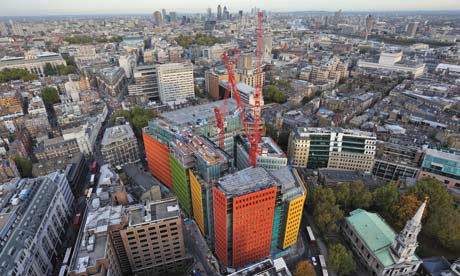
Over the past decade I’ve been living around more than my fair share of large construction sites, and I’ve enjoyed their cranes' sudden appearances, their elegant slow movements for a couple of years, and then their equally sudden disappearances as the hoardings come down around the brand spanking new building they helped to construct. The way they hover delicately over the weighty assemblage of static material below them, engaged on tight sites in a slow, precise and controlled choreography in the sky above the building so as to deliver bundles of material without knocking into each other, somehow without being swayed too far by the wind, and without damaging anything, or anyone below. And up there in the little cabs, like the minute brains of a stick insect, are the crane operators, heroic and alone, who I only ever saw as the sites would shut operations for the day, and probably in response to an alarm in their cabs, or a call on the mic, the cranes would come to a halt, frozen in position, and they would all descend simultaneously from their cabs, level by level down ladders on the insides of the cranes’ far too slimly proportioned structure, taking breaks at the same landings on their way down, perhaps as a prescribed precaution, until they disappeared from the view of anyone outside the site’s hoardings, either to have a cup of tea and discuss the day’s more exciting moments, or else to run on home. The first entry on this blog, back in 2008 was a retelling of the impact that the cranes on the site of Renzo’s Central St Giles had on me, on a freezing cold night, together with the sheer battlements of that project’s clustered cores. I'd thought it magnificent, and as his multi-coloured confection opens its doors to its unexciting content, and as its beautiful construction process passes into memory, I have a crane that has appeared, right in front of my bedroom window, in the last week. No soaring beauty to this crane, but I did notice that I can almost make out how the man inside might look, his proportions, and that there isn’t a toilet up there, and the operator doesn’t leave the cab all day. On further research Ive learned that they are either magnanimously handed piss pots by the firm to urinate in, or they have to improvise something along those lines, of the mineral-water screw-top kind id imagine, which they keep with them all day, no doubt handling them carefully as they descend in said orderly fashion as the site closes. The operator facing my room also seems to have a computer up there, and, wondering if there are any forums for discussion and socialising on the net used specifically by the class of 4000 lonely crane operators around the country who could no doubt do with a bit of company (this new crane is the only one on site), I rummaged around and found the trailer of what looks like a beautiful film here, and a discussion forum, from which are some snippets below, direct from those who get to live a distinctly alternative, and fascinating London High Life:


Forum Discussion Started With A Member’s Poem:

never mind the b*ll*cks!!!!!!!!!!

When the jib slews still,
the magic moment arrives,
its free slew button time,
and now for the climb.........down down down wheeeeeeeeeeeeeeeeeeee away home,
no more b*llocks,
no more lifts,
F*** you and ,
yer horrible concrete.
no more radio babble,
its motoring time,
its 12 hours at least,
before I have to see,
those knobjockeys again,
and they see me,
so give me steak and chips,
ya ba*stards,
and F*** off till tomorrow.

I wrote this little poem for your pleasure or scorn, as you can see its poetical scope is limited,rather akin to a gorilla with Parkinsons trying to play a violin with a hammer. Sorry.

Forum Discussion About Accessing The Net In Crane Cabs:

Writer 1: just wondered who else sits up their crane with the laptop plugged into their mobile surfin the worldwide between lifts??or maybe ya poached your connection from a nearby wireless con.??? 
made a great table to sit the old laptop out of me info screen +operations manual...
Writer 3: was on job in dublin on the quays, was on relief one day, went up tc 2, christ like bloody comet up there.........laptop, digi radio, lcd tele and ps2. I kid you not. 
Writer 4: i worked for elliotss on dublin quay and had my laptop tv radio play station kettle irish broadband and loads of of other s*** pluged into two 4 sockets come out of one lol f*****g best job in the world.
Writer 7: I brought up me mobile DVD player and I could'nt see a fooking thing on the screen with the light in the cab,maybe you'll see a bit if you put a magazine over it but its very uncomfortable,less you put up curtains all round the cab,would'nt say the foreman would think that was suspicious, hehehe,thought it was'nt worth a w*ank,is it not the same for laptops????????
Writer 8: i bought an 8in lcd tv from amazon.co.uk.it cost approx £70 with postage. 
its got the 35+ channels from freeview.you can also use it as a freeview set top box at home (i think) 
its an 8in x4 tech . 
im in london and have been impressed with the quality of the picture from the aerial. 
below is the model spec. 
X4-TECH SOL8 DVB-T TV Silver


Forum Discussion About Difficult Cranes:

Writer 1: Anybody hate their crane ??????? ehhhhhhhh?????? anybody like to give it a good kicking?? cant quite figure out the timing ?? horrible slew brake?? cab that shakes to F*** every time you look at the levers ??? small and uncomfortable cabs ??? ehhhh??? anyone like to break off the levers and chew em before hurtling them out the window??
Writer 4: There was a haunted Jaso crane in Dublin that still operates that I for one hold up my hands and say that I still dont know what the F*** was going on there,I could'nt conquer it at all, it was certainly haunted as it had a mind of its own and made the strangest noises ever , not ya run of the mill crane groans but horrible fooking screeching all day, when trolleying back the trolley would suddenly get a massive bump and shake the whole jib like F***,when slewing as I came to the mark it would stop as normal and then suddenly the whole jib would violently shake sending the load beserk making me look like a tw*at driver,I dont know whether it was a violently deranged slew brake with a mind of its own or what and I dont give a F*** either long as I never see that crane again,nice vertical ladder it had up to it too,lovely, I felt numb driving home after driving that bas*tard and had to lie down a horrible horrible cu*nt of a crane,I hope they fooking cut it up with giant skill saws and melt it down into gates or fenceposts or something,anyone else got a crane they hate ??????????????
Writer 13: when it comes to comfort you cant beat a saez insainly small cab, a fixed seat off a site dumper. no form off adjustment so you can have a decent kip oh and the only way to get in the cab is to clime over said seat. and not forgeting dead man on the levers that make your fingers bleed keepin the ba****ds up.apart from that not a bad crane

Forum Discussion About Summer Heat In A Crane:

Writer 1: not looking forward to this summers heat.i hate the heat when you are up crane.winter is the best, you feel cold nock the heat up one in the summer you feel hot you feel like hitting someone .
can anybody tell me why there is no aircon. NO I WILL TELL YOU THEN
i rang my boss two years ago when it was hot 51 degrees in the cab ,site managers told me to come down the crane it was so hot.
my dear boss said its just another reason for drivers to refuse to climb the crane when it stops working.like when you have no heat .which is true because if i had no heat the site has no driver.but come on the summers are getting hotter and iam getting fatter i need cool air ...
anybody else find summer stressfull please tell 
  
Writer 4: Luckily some cabs heaters can be set to cold, but your dead right there aint nothing worse than sweating like a *astard on a hot Summers day up a cab, even with all the doors and windows open its horrible, except for those celestial moments when a cool breeze blows over the entire cab,like Nigella Lawson just breathed on yer , oooooooooooooooooooo, ,on days like this one feels like a lion after a heavy feed that wants to lie down,its Spring now anyway, wont be long before the sellotape and news papers will be going up on the windows to keep out that sun.
Writer 6: Top tip lads - Get yourselves one of those beaded car seat covers.  Nothing like it for promoting air flow in the crack of doom on those hot summer days 
Writer 9: that hot summer a couple of years ago, the site my bruv was on put a water cooler in his cab!! freezing cold water on tap! bloody brilliant. What is the score with heat?? soon as i am out of juice i am down for a refill or get the good old slinger to bring some up. He gets a shock when he sees me sat in my skiddies looking like a porn star!!
Writer 10: Gives me cause to wonder Merlin what can you imagine would be the most uncomfortable outfit you could wear for a days driving?????????? I think a pair of pinch tight jeans (the type that chokes yer knackers like a python curling around a rat) with a hand knitted heavy jumper with no t-shirt on underneath and marching boots with gimp leather face mask and ear muffs the size of dinner plates, anyone else got anything they can think of, the more ridiculous the more we will respect you.
Writer 12: HOW ABOUT CLOGS OVER THICK HIKING SOCKS, DOUBLE PAIR, CHAIN MAIL TROUSERS WITH SACKCLOTH UNDERNEATH, MONGOLIAN TRIPLE FUR JACKET OVER A DONKEY JACKET WITH AN ARAN UNDERNEATH ,DOUBLE MONKEY HATS WITH A COLDSTREAM GUARDS ARMY HAT ON TOP,ZORRO FACEMASK WITH THICK FIFTY PENCE GLASSES ON,MIFFS MADE OF RUBBER FOR THE HANDS WITH A WEIGHTLIFTERS BELT AROUND YER WAIST ASWELL AND A PAIR OF HUGE FAKE PLASTIC PARROTS GLUED TO YER SHOULDERS!!!!!!!!!!


Are you a narky *astard of a driver ,ready to be a source of abuse and grief at slightest oportunity ? or are you a nice driver willing to help anyone to get through the day easy before you go home ? this special quiz trys to answer these questions, answer A , B or C, collect points and see how you get on at the end.......................... 

Q.1 Whilst walking to the canteen a member of site management innocently cracks a joke about drivers pretending its too windy, do you................ 
(a) Laugh lightly and continue on yer way with yer sensible lunch in yer bag and sit down . 
(b) Firmly but not rudely tell him that the wind speed is obove the recommended limit and your hands are tied on the matter. 
(c) Grab him in a choke hold till his face turns blue, the banksman rushes in and manages to persuade you to stop. 
******************************************************* 
Q.2 A self erecter driver has inadvertently slewed into yer path dropping off some shutters, do you 
(a) Wait for him to slew outta the way, you drove them before yerself and know that its hard enough driving on the ground sometimes. 
(b) Ask him to slew outta the way as soon as the load is down. 
(c) Scream down the radio to get that fooking pile of sh*ite outta the way quick smart or there'll be trouble. 
***************************************************** 
Q.3 A scaffolder relizes that he wanted the stillage over another ten metres to the left, do you .............. 
(a) Say no probs into the radio, cheerfully slewing another ten metres left. 
(B) Remark to the banksman that them scaffloders are always changing their minds whilst bringing it over. 
(c)Slam it down on the slab where it is shrieking like a maniac for them all to F*** off. 
*********************************************** 
Q.4 A load of Romanians are doing the pour on the concrete, they want you to follow them around so that they dont have to rake it all over the place , do you................. 
(A) Diligently jab the levers ,controlling the skip smoothly travelling where they need the concrete. 
(B) Wave yer hand to them saying yes but mutter under yer breath that they are letting the concrete out too fast and to give yer a chance to adjust. 
(c) F*** THEM !!! 
**************************************************** 
Q.5 Its starting to get a liitle windy but not too serious, do you.............. 
(a) Keep an eye on the windclock and be extra cautios in case someone hurts themselves. 
(b) Tell the banksman that its getting a little windy,we can keep working but no shutters you are both in agreement. 
(c) Block up, radio off , you use this opportunity to ring up yer Missus and tell her you fooking hate her or get stuck into yer porn. 
************************************************ 
Q.6 The foreman who is actually a sound head and well liked by the crane staff walks into the craneys hut on the break, do you............... 
(a) Shout alright mate with all the other lads and ask him does he want a cuppa as their is still twenty minutes left. 
(b) Give a reserved hello and be friendly watching what yer say though ,as he is management and you have to watch what yer say. 
(c) Stare at him when he says hello saying nothing with a look that would give Charles Manson the creeps. 
*************************************************** 
Q.6 A fumbling but friendly safety officer calls a toolbox talk for the craneys and banksmen, do you................ 
(a) Sit there with the rest of the lads outlining safety concerms that you feel need to be addressed, but listening to everyones point of view aswell. 
(b) Sit there and laugh at the corny jokes it'll all be over in a while, you've been driving twenty years and know bettre than most. 
(c) Sit there fuming for no particular reason suddenly bursting out with an unintelligible rant about how the brickies are all *unts and noone understands F*** all in this kip, kick over a couple of chairs on the way out. 
*****************************************************
Q.7 Another craney comes over the radio asking you to slew left please as he just wants to get a couple of blocks in, you havent even got a load on yer ropes and have'nt done a lift in hours, do you............. 
(a) Say no probs mate slewing outta the way in moments giving each other a friendly wave as yer do so, 
(b) As obove. 
(c) Shout "listen yer *unt, I'm the Daddy on this site , the big crane does'nt have to give way so BO*LLOCKS!!!!!!!!!!!!!!!! 
***************************************************** 
Q.8 The banksman makes a small series of mistakes during work, he is not at it too long and apoligizes, do you.............. 
(a) Remember when you were banking and the mistakes you made and carry on regardless. 
(b) Your a bit annoyed but as we've said yer know better, yer driving twenty years for Petes sake. 
(c) Yer up in Wormwood Scrubs prision, the judge gave you a whole life tariff over what yer did, (gulp) 
******************************************************* 
Q.9 Whilst walking to the canteen a harmless but annoying brickie makes a silly comment about not getting his lifts, do you............... 
(a) Say "sorry mate, but we really are quite busy, but I shall do my best for you after the break,cheerio". 
(b) Inform him that the crane is busy and if he has a problem to address it to the crane co ordinater, yer not being smart with him yer just telling him whats going on. 
(c) Use yer army training to trip him up and jump on top of him brandishing a bowie knife up to his throat gibbering incoherently that yer gonna cut his fooking gizzard out, a banksman starts pleading "no mate , leave it, its twenty fooking yers mate, for fooks sake calm down man". 
****************************************************** 
Q.10 Yer walk into the pub across the road on Friday evening where all the drivers and banksmen are, do you.................. 
(a) Shout hello and pull out yer money buying around for everyone quicksmart. 
(b) Just sit down with yer cash and buy a round for the banksmen that you know yerself. 
(c) Pull yer wages outta yer pocket and sniff the fresh crisp notes as if it were Nigella Lawsons's scants before ordering two pints, one for yerself and one for ermmmmmm yerself before sitting down and getting drunk pi*ssing everyone else off with yer rude banter. 
**************************************************** 
If most of yer answers were A or B yer a sound head who likes an easy life with no probs,yer there to earn a living and no more...................... 

If yers answer were mostly C , yer a belligerent *astard who gives noone a chance,yer only happy when yer being a *unt, anything sets you off, its like driving a lorry load of nitro gylicerine around a stock car track on a good Saturday, CHILL OUT !!!!!!!!!!!!!!!!!!!!!!!!!!!!!!!!!!!!!!!!!!

Monday, 15 November 2010

Makeup, Or The Tyranny Of Truth: Extract from J. Lichtenstein's "The Eloquence of Colour" #2


The Three Graces By Peter Paul Rubens, Museo Del Prado Madrid


MAKEUP

"Deceitful makeup spread over paintings with an adulterous talent"
Hugh of St Victor Didascalion

"Ornament may be necessary to Beauty, but too much ornament ruins nature and truth. Thus we might sum up an aesthetics that dominates throughout the Middle Ages and to the Classical Age, and from which our discourse has never really departed. This principle, as we recall, implies a distinction essential to all metaphysical aesthetics, which allow the separation of the wheat from the tares, the distinction of ornament from make-up. Used to excess, ornament becomes makeup and dissimulates the truth instead of bringing it to light. This rule applies to discourse as well as painting. In the first case, it concerns the din of words, indulgence in metaphors, and overabundance of tropes, accused of masking things and obscuring the purity of the idea. In the other, it has as its target the brilliance of colours that are criticized for hiding the figure, for burying  the drawing and corrupting its effectiveness.

Metaphysics has always taught the secrets of cosmetics that apply indiscriminately to language, the image and the face. The same knowledge offers a delicate way to highlight the structure of a face by thinning the eyebrows, defining the mouth, shading the eyelids, or hollowing the cheeks; the subtle ability to shade a concept, underline an idea, illuminate an opposition; or the skill to tone down a line or a colour in a drawing. In each case, the prescription is the same: ornament must not be seen but must make its object visible, it must show without showing itself. The difficult techniques of makeup clearly confirm the ancient saying that art must always remain invisible. If a faint shadow transforms and eye into a glance and thus marks the passage from insignificance to existence, makeup that is too lavish, by contrast, takes on the unreality of a mask.

The constant warning against the dangers of artifice whose effect is not self-effacing, the continual distrust of ornament that shows itself as such instead of hiding, attests to a fear that tradition consistently upholds. It is a profoundly ambiguous fear, expressing the simultaneous and conflicting fear of being deceived and desire to be deceived. For artifice, accuse of trapping the subject in a web of culpable seduction and illicit pleasure, is also asked not to display itself or reveal its own procedure. If artifice indeed deceives, then art is obliged to be doubly deceptive, as if the victim’s ignorance legitimated the artifice and art shed its guilt at the very moment that it became a lie rather than a simple ornament. Perhaps aesthetic pleasure is philosophically acceptable only if it is born, not of seduction, but dupery.

Most of the difficulties raised by the question of artifice, indeed, stem from the fact that it always conflates two very different problems: that of deception, which concerns the objective and perceptible effects of artifices, and that of the deceiver, which has to do with the moral investigation of intentions. The analysis of art’s effects falls back onto that of the ends that the artist sets for himself in artistic creation. Such an operation tends to omit the aesthetic question proper, since it uses psychological and moral categories that apply to the subject-painter to interpret the object-painting. On the contrary, in distinguishing the artist’s sincerity from art’s deceptions, Roger de Piles shows his intent to dissociate the two perspectives. When he defines the essence of painting as deception, this notion has no moral implications. It does not claim to judge an intentionality but a perceptible effect. The psychological analysis to which it refers does not involve the relations between artist and art but those between a painting and its viewer. The fact that art depends on artifice does not warrant the conclusion that its character is more deceptive.

Paradoxically, a purely aesthetic position like that of Roger de Piles is the only one that can avoid moral criticism, since its asks artifice to show itself, that is, to show how it deceives. But we have already encountered this paradox in the analysis of rhetorical representation. To throw the accusation of deception back onto philosophers, Quintillian had only to show that eloquent discourse, based on effects alone, was never deceptive, unlike philosophical discourse that claimed to be the discourse of truth. Roger de Piles’ procedure for turning all the prudish critiques of the artifice of coloris back onto their authors is analogous. He affirms that artifice in painting is not deceptive, since it presents itself to the eye as an object of delectation. It is not a deception but an effect of deception that the viewer enjoys only if the deceptive effect dissolves as soon as it acts on him. In this sense the aesthetic experience, unlike the image often given of it, is inseparable from the movement of reflexivity that characterizes consciousness. It demands an instantaneous reflexivity and an especially sharp wit, since conscious processing must occur at the same instant that the perceiving subject vacillates. Here, the reflexive distance implies not detachment from the object but rather recognition of its seductive charms; the gaze no sooner recovers from its surprise than it delights in the object that has captivated it. Critics accuse painting of being a deception on the pretext that it is only an appearance. But this is precisely the point: it is but an appearance of deception, a lie that deceives only the naïve who do not know how, or do not like, to look; a deception that does not really deceive, since it shows itself. On the contrary, when artifice hides, then it becomes truly deceptive in the moral sense of the term –a blatant falsehood.

Such is the paradox underlying most discourses that set forth rules in the art of cosmetics. They use a logic of truth whose ultimate reference and sole criterion is nature. Naturalist thought, by refusing to grant the pleasures of artifice the slightest legitimacy, forces artifice to disguise itself as nature… Nietzsche says that art’s illusions, unlike those of science, philosophy or religion, are not lies because they do not try to pass for truths but present themselves simply as what they are…To ask art to hide itself obliges art, in a sense, to pay homage to nature. A referential logic of truth thus replaces an aesthetic approach to seduction. And his obliges art to become what metaphysics has always claimed it was: a deception of the subject, a lie about reality."

Saturday, 6 November 2010

A Red Rubber Band On the Pavement


Freedom Of Information Request To Royal Mail by Steve Woods, 10 December 2008:

Dear Sir or Madam,
I cannot help noticing that all the streets round my area of Bristol are frequently littered with the rubber bands used to collate bundles of post for mail deliveries. In the light of this could you inform me:

1. How many elastic bands - in terms of either numbers or weight - does the Royal Mail procure and/or consume per year?

2. How many postal delivery workers have been fined or successfully prosecuted for dropping litter (i.e. the said elastic bands) in the last year for which records are available?

3. What steps are being made by the Royal Mail to stop such littering and to recycle elastic bands?

Yours faithfully,
Steve Woods

………………………………..

Royal Mail Group Limited Reply 12 January 2009:

Dear Mr Woods,

Thank you for your request for information by e mail received on the 10th December 2008. We can confirm Royal Mail holds this information. In your request you specifically asked for:

1. How many elastic bands - in terms of either numbers or weight -does the Royal Mail procure and/or consume per year?

For the last three years, the number of rubber bands used by Royal Mail was:

2007/8 871,695,000
2006/7 825,750,000
2005/6 753,480,000

2. How many postal delivery workers have been fined or successfully prosecuted for dropping litter (i.e. the said elastic bands) in the last year for which records are available?

Royal Mail Group has not been served with a fixed penalty notice or prosecuted for a littering offence under the Environmental Protection Act 1990 arising from the discarding of elastic bands. Royal Mail Group would
not necessarily become aware of such action being taken against individuals. However, we are not aware of any delivery officer having been prosecuted for littering when discarding elastic bands.

3. What steps are being made by the Royal Mail to stop such littering and
to recycle elastic bands?

Royal Mail re-uses many millions of rubber bands each year and bands are generally re-used within delivery offices and mail centres. We remind our people about the benefits of re-using bands and also ask them not to discard them after use.

Royal Mail uses millions of rubber bands each year because they are very useful when it comes to sorting and delivering the mail. Unfortunately, given the quantity that we use it is inevitable that some rubber bands will be dropped by mistake. The vast majority of our people are hard working and conscientious but, and as with any labour intensive organisation, errors will occasionally happen. Issues concerning the environment are very important to us, in particular those of street cleanliness and recycling. The rubber bands we use are specifically designed to be more biodegradable than the normal brown rubber bands and this is intended to lessen the environmental impact.

Going forwards we have a number of process reengineering initiatives that should reduce the volume of elastic bands we use in our operation:
• collection reengineering
• customer traying
• Reengineering mail handling equipment

If you are dissatisfied with the handling of your request you do have a right to request an internal review, in which case please write to the Head of Information Compliance, Royal Mail House, Company Secretary's Office, 5th Floor, 148 Old Street, LONDON, EC1V 9HQ. An internal panel will then review the request, and you will be advised of the outcome.

If, having requested an internal review by Royal Mail, you are still not
satisfied with our response you also have a right of appeal to the
Information Commissioner at:
Information Commissioner's Office
Wycliffe House
Water Lane
Wilmslow
Cheshire
SK9 5AF
Telephone: 01625 545 700
www.informationcommissioner.gov.uk

Yours sincerely,
Marie Teasdale
Freedom of Information Case Officer
Company Secretary's Office

Thursday, 28 October 2010

"Her Chambre Bleue" at The Hospital Club


A performance of two discrete but simultaneous parts by Ilona Dorota Sagar with text and spoken word by me, that was performed last friday. Dancers dressed in blue moved around the space (a bar and socialising space in a relatively exclusive members club in Covent Garden, London) blocking people's paths, dividing the crowd, slipping between and under people, and splaying themselves along the walls, bar and carpet; at the same time four actors dressed anonymously approached people as if they were acquainted, and eagerly told them one of the three pieces of text below, which weave together the space of the Hospital Club and its furnishings, together with the Salon of Mademoiselle De Vivonne in the Hotel de Rambouillet, and all of its refined luxury. The first texts are the initial version prior to a collaborative rewriting and editing with Ilona, and the second set are the final scripts that were spoken on the night. You can see a short video of some of the event here over on HandBin.


Version 1:

Don’t mind them, or rather do, but only so much as you might mind a well-positioned crystal chandelier or framed piece of art… let them be in the periphery, like a thought that reminded you of something, but you can’t remember of what, or like a smell that takes you somewhere precise and vivid, but nowhere that you can actually place… or rather I think it is them that are trying to remember all of it for you: each time they line up and their legs lift in unison it looks like they might have once been at a ball, an evening that they cannot quite recall, and whenever their arms lift out and they lean forwards it’s like they are trying to recollect the movements of a formal greeting, a movement of decorum, but, poor decorative things that they are, they can’t quite bring it all back to mind, and little do they seem to realise, poor dolls, that it’s the Prussian summer-evening-sky-blue of their leotards, and the gold smeared on their lips, which is what they are trying to grasp. It is the Chambre Bleue, and its sparkling gilded domes, the dances and discussions with little flutters of tiny pouting lips which they think they can find here, somewhere in this room, but they don’t even remember what they are looking for, poor souls.

Cobalt blue, Azure, deep and dazzling all at once don’t you think, particularly when they dance around with it like that, so much ease in their movements, but it really isn’t that easy, what they’re doing, they just make it look like it is, a lot of training you see, the kind of training that used to be expected in places like this, one couldn’t just say what came to mind, it had to be said beautifully, one needed wit and no little charm, now they don’t even open their mouths, and that blue, it wasn’t always just a pleasure to look at, it was a deadly game Cobalt was, named after a German sprite, an angry little gremlin that lived in the mountains and hated visitors so much that the Arsenic in the Cobalt mixture would eat away at the miners’ feet, and tear apart their lungs, but it looked beautiful on the canvases on the walls of all the Salons, and on the hemlines of dresses, and on letters that they would write to each other in intrigue that would look blank until they were heated and their slanderous words would appear by candle-light, blue lines written beautifully about the blue room, hard work and dangerous though it was.

I have a little vignette to paint for you, it’s helpful you see, an instruction on these dancers, and their delicate moves. It’s a scene, an atmosphere, you see, that they are repeating, again and again. They speak as one, dance as many, and they have a nose for luxury, I tell you they can always sniff out what is genuine and what is not, they have an eye for elaborate artifice and no patience for dreary imitation, in you and me, whoever they come across, and they let you know. Somewhere past, in a room like the inside of a rock of Lapis Lazuli, somewhere between the Tuileries gardens and the Louvre, four men approached them in greeting, hoping for a dance to a fashionable minuet, and, like judges at their own court of subtle suggestion they delivered their verdicts by hand and foot and mouth for everyone to see: Leg up and hand outstretched they delightedly say “Monsieur, I am honored to present you my most humble respects in this dance”; leaning to the left with their hands pointing up they respectfully twitter “Monsieur I am your most humble servant, follow me”; shoulders slouched and falling to their left they politely retreat with “Monsieur, I am honored to greet you. Perhaps another time”; and finally, in the presence of ill-concealed pretension and failed elegance, collapsing into one another they say with ice “Hello, Monsieur”.


Version 2 (as performed):


Don’t mind them, or rather do, but only so much as you might mind a well-positioned crystal chandelier or framed canvas… let them be in the periphery, let them recede into the background like the splashing of a water feature in a hotel lobby, like the pantone hues of polyester resins mixed with stone dust, imposters, masquerading as travertine, onyx, marbled alabaster, and in the corner of your eye they become grandiose facades impervious to rot or tedium, they become bold statements that flatter your presence with the paper thin grandeur of Faux Bois and brocaded polyester, thin veneers and fragile illusions that wrap you, and a select other few in attenuated adoration, raised above the mundane and cradled in the reassuring glow of purchased luxury. Catherine de Vivonne is here. In every lavish soft furnishing and carefully chosen surface. I think it is that space between the dancers and the designer detailing that is trying to remember it all for you: Her salon, that perfectly formed private world, The hidden arrangement between her daybed and the wall of her alcove. As each arm lifts out and they lean forwards, it’s like they are trying to recollect the movements of a formal greeting, a movement of decorum, but, poor decorative things that they are, they can’t quite bring it all back to mind, and little do they seem to realise, little dolls, that it’s the Prussian summer-evening-sky-blue of their leotards, and the gold smeared on their lips, which is what they are trying to grasp. It is the Chambre Bleue, and its sparkling gilded domes, the dances and discussions with little flutters of tiny pouting lips which they think they can find here, somewhere in this room, but they don’t even remember what they are looking for, poor souls.

Cobalt blue, Azure, deep and dazzling all at once don’t you think, particularly when they dance around with it like that, so much ease in their movements, but it really isn’t that easy, one couldn’t just say what came to mind, it has to be said beautifully, one needs wit and more than a little charm, now they don’t even open their mouths. they are mute, and encased in a moving form of restraint and decorum. It’s not something that can be learned, or even easily taught, this honnetete, a code, a way of dancing, greeting, joking, talking, in fact for us conversation is a sacred art, it is the medium through which the group, our group, develops its sense of style, its taste. Look at them fluttering in the background, decorative and decorous at once, all blue and gold, delicate like the soft blue-green colour of ancient Chinese porcelain, whose name Celadon was once conjured up by them, together in a conversation at the Hotel de Rambouillet. As was their habit, inventing words, and painting things with them, as well as with spectacular pigments, saturated and dripping as Catherine de Vivonne’s Salon, Royal Blue from top to bottom, and the first grand colour of The Queen of Mecklenburg-Strelitz’s dress, as luxurious and decadent as the velvets and cashmeres strewn over their divans and chaise-longues, lying lazily in corners after their exhausting and exotic journeys across half the world, from the hands of Kashmiri merchants, a role now passed down to the elegant sways you see here that are so becoming, made from rayon instead of cashmere, and having passed through container ports and delivery trucks instead of Caravanserai and Clippers. There is Plywood here too, as well as MDF, drywall and chipboard, synthesised materials that strain every atom of their amalgamated substance to reach back, simulating gestures towards the past and backwards through history, in a delicate and precarious state of imitation denial.

I have a little vignette to paint for you, it’s helpful you see, an instruction on these dancers, and their delicate moves. It’s a scene, an atmosphere, you see, that they are repeating, again and again. They speak as one, dance as many, and they have a nose for luxury, I tell you they can always sniff out what is genuine and what is not. They have an eye for elaborate artifice and no patience for dreary imitation, in you and me, whoever they come across, and they let you know. Somewhere past, in a room like the inside of a rock of Lapis Lazuli, somewhere between the Tuileries gardens and the Louvre, sat the Marquis de Rambouillet, holding court in a dress the colour of the sky, with blue blood coursing through her veins, always with a keen eye to the rarity and refined allure of everything her guests would say, wear, or carry, diligently watching for the sumptuous pleasure of an even more exceptional and precious fabric, jewel, colour, or phrase, and the sensuous thrill of refined novelty it would suffuse in her Chambre Bleue, layering it with a coating of velveteen grandeur, a layering of unique and unobtainable refinement that has hardened over the years into a veneer, a fragile and thin emulation of the Marquis and her guests’ discernment and grandeur. The desire to belong is steeped in the same exclusivity, only its manifestation is played out in emulsion wall paint, ply and replica chandeliers, a manufactured sumptuousness which whispers the desire to act out social gatherings of a grander era, a time that bathed in the glow of a reassuringly singular and bespoke luxury.


Tuesday, 12 October 2010

The Graveyard And The Morgue: Spaces of Signification

"The whole visible universe is but a store-house of images and signs to which the imagination will give a relative place and value; it is a sort of pasture which the imagination must digest and transform. All the faculties of the human soul must be subordinated to the imagination, which puts them in requisition all at once."
From “The Painter of Modern Life” by Charles Baudelaire


I was harsh on those impeccable places of cultural commodification and serial exchange that are embodied in black boxes and white cubes. They are a form of divine reduction, an elemental abstraction that cuts ruthlessly to the core of their structural purpose. They proudly proclaim the point at which economy can –so far- go no further in its demands for the reduction and conflation of space, and time, into uniform, measurable, quantifiable, and statistically relative units, units before which goods and value can be consistently registered and transferred. They analogise and mark the precise threshold beyond which traditional space, with its already tenuous grip on relative function, simply implodes in on itself as everywhere actually does become the same, and all goods, all forms of observation and exchange, all events, are available at any time and in any place. The reason they are so numbingly devoid of qualities is that they are the banal precipice, the very terminal point, of physical space constructed by man. They are the exact moment before it disappears, and so they are etiolated to almost nothing, for that is what they are destined to become: nothing. Their contract with what they contain is almost completed, and they will disappear.


Morgue of the Middlesex Hospital, London, prior to demolition, 2008

I was unfair to call their disposition a ‘Morgue of Spatial Utility’, a description tinged with what could be seen as a disrespectful attitude. However I would like to point out that a Morgue is a fascinating place, it is a purgatory of the flesh, a stretch of time in which a body has lost its soul, but has yet to be conferred to memory, yet to be commemorated, and concluded, with any ceremony or symbol. It is a place of irreducible human vessels. It is the place where we are essentialised to a level of absolute classical (or modern) simplicity which could never have been achieved when intermingled with the complexities of life, and will never be possible again either in the mirror image of life that is the graveyard, or in the extinguishing nothingness of permanent oblivion. I see this as a severe significance, with its own beauty, but hateful and provocative to those like me whose sensibilities yearn for something more voluptuous and full of life, but they are nonetheless infinitely preferable in their rigor to the towering collapse of expectation, and muddy indistinctness that arises when a desire for uniqueness, for rebellion, in all its naivety, meets with its opposite, and produce a bastard offspring.

Since Im now in the habit of using places of the dead to analogize my point, lets move on to the graveyard in search of an alternative to those monochrome boxes. They are feeling all the more stifling for their apparent triumph and superiority.


Recoleta Cemetery, Buenos Aires

Morgues may be fascinating, but I would be transfixed with a clinical terror if I were ever caught in one alive, perhaps not feeling dissimilar to how I am so often withered by the interiors of galleries. Cemeteries however, with their tombstones poking up all over the place, profusion of strange symbols from every period and walk of life, inexplicable formal concoctions animated by the love with which they must have been considered, I have always found to be most inviting. They simply force your imagination, no matter how flabby and asthmatic from inactivity, to start playing with all their suggestive concoctions, which is why they drew me so often at a young age to sit amongst their tumbling ivy at dusk, crouched atop their largest tombs, the ones closest to collapse, in order to make up long and meandering, nonsensical but riveting stories.
Where the morgue is the tight abstraction of the classical cube, skeletally containing the human body as enabling container devoid of life, the graveyard is, in its best examples, a specular landscape of flourishing symbols, each conveying nuanced impressions of individual cultural calibrations. It is the opposite of the morgue, it is all the material associated with the fleetingness of style and personality, of longing and affectation, frozen for perpetuity. The morgue relies on its lack of signifiers in order to emphasize the structurally essential nature of what it contains, whereas the cemetery does the opposite, implying and representing the very thing that it does not contain (the personality, the loved one), through the fleshiness of its signs.

If, like me, you see the truth in what Baudelaire says in the extract above, then perhaps the profusion of the cemetery is preferable to the essentialism of the white cube (sorry, morgue). It at least provides more material for the imaginary gland to metabolize. And even if it is not entirely preferable, if there is still love for the clear equations, and clarified relationships of the box, then I don’t think it would be outlandish to say that it might at least hold more value together with the cemetery than alone, might form a productive correlation as complementary opposites. That the qualities of both might frame the two poles of a way to judge spaces and how they perform seems reasonable.

Pere Lachaise Cemetery, Paris

The one for the mathematician architect longing after universal transcendence minus experience, the other for the architect who wants to partake in that unstoppable and divinely comic attempt to touch beauty, or truth, or simply what lies inside each of us, that contingent and protean thing we often call style and fashion, the manifestations of our transcendent human subjectivity: a wonderful affliction, that affects thinking as much as material display, thank God. An affliction whose itching unease is catalogued as frozen moments, in miniature form, in our graveyards, is rendered grandly and slowly in our cities’ buildings, and is displayed raucously every day (but never for more than a day, a week in the same state) in the clothes on the backs of everyone in our streets.

Sunday, 10 October 2010

Black Box White Cube


those abstracted vacuums pumped free of any contaminating atmosphere;
those manifest vacancies scattered around our cities in perfect seriality;
those ideal formulas of neutralised tensions, of disregarded imbalances
are spatialised formulas of a completely vacuous religiosity,
of comprehensive operational performance.

In them Architecture has reached the conclusion of its long journey in pursuit of performance, it has arrived at the stage of pure and total utilisation and finds that it has erased itself, that in its pact with the theatre and the gallery it has reduced itself to being a negative, a lack, an absence. And it is this thin skin of effacement that both sublimates Architecture and traps Art in a contract of suspension, a collusion in which Drama and Art is frozen in its own ludicrous morgue, captured in the placeless stasis of the black box and white cube's nowhere, and in which Architecture willfuly obliterates itself in the ghostly reflection (black or white) of its own ultimate achievement.

Wednesday, 15 September 2010

The Aesthetics of Garbage & Venetian Mirrors


A tract taken from an early chapter in Michel Tournier’s “Gemini”, in which the main character, the owner of a refuse disposal company who revels in the amphibious contradictions of his lifestyle, being variously an elegant and precise gentleman of impeccable manners, and a gutter-licker who believes that “there is no such thing as a good, or bad smell”, elaborating the oceans of connoisseurship and delight that come from the discerning analysis and appreciation of the body’s and the city’s most unspoken of and rejected parts, from the rubbish tip to the young vagrant’s anus. It is never a matter of good and bad, but a matter of degrees, potencies, combinations and allusive affect, effectively extracting any moral or hygienic layer that may have been involved in judgement, and replacing them with a pure compound of sensory aesthetics.
Similarly contrary is his position with regards to consumer society, whose rapid turnover of goods, and infinite chain of manufactured copies destined for the trash heap, he finds ludicrously beautiful, since as he says below, he sees in every remove away from the mythical-illusory aura of an original object, a correlative increase in the vigour of artistry, sees a clear and honest reflection of the world’s state, of the complexity of human production and its edifice of mirrors perfectly encapsulated in its own detritus. The Ouroboros of capitalist progress, of innumerable productions, reproductions and recombinations, that hurtles round in circles feeding on itself in a protean helix, sheds its skin as it replicates itself, and it is the compounded layers of these skins that he spends the book digging through, managing the gases these remains produce, and describing the delicate differences manifested in each city within its dumps, as well as the marks history’s ruptures leave in these pits of sediment, mountains of dead dogs shot after they were left by Parisians escaping the advance of Hitler’s army and all.
Sitting here in 2010, our world has become strangely similar to his rubbish tips, where time gives way to space and all objects and sequential events collapse into a compressed simultaneity as we hopscotch ever faster across and around our own history, picking up whatever we wish from wherever within the accumulating tip that swells underneath us, copies having proliferated to the point where there is, brilliantly, no such thing as an original, and all evaluation rests (like Tournier’s character with his clear qualitative system and mythology of rubbish, sex, and society that accumulates the most unexpected objects, and boys) on the act of engagement with whatever is appropriated by that person, or that group, and how actively they manage to weave it into a new chain of significance.

The Aesthetic of The Dandy Garbage Man from Michel Tournier's "Gemini"

“The idea is more than the thing and the idea of the idea more than the idea. Wherefore the imitation is more than the thing imitated, because it is the thing plus the effort of imitation, which incorporates the possibility of reproducing itself, and so of adding quantity to quality.

That is why in the matter of furniture and works of art, I always prefer the imitations to the originals, imitation being the original encapsulated, possessed, integrated and even multiplied –in short, considered and spiritualized. The fact that imitations are of no interest to the general run of collectors and enthusiasts, and may also have a very much lower commercial value than the originals, is only an additional advantage in my eyes. For that very reason society will have no further use for it, and it is destined for the rubbish heap and so fated to fall into my hands.

Since it does not contain a single genuine object –except perhaps for my collection of sword sticks- my home in Paris is entirely made up of the second-rate. I have always dreamed of elevating it to the third-rate, but if there are such things as imitations of imitations they are so rare, and doomed to perish so quickly from the fourfold contempt of the idiot mob, that I could furnish my house with them throughout only by going to immense trouble. Nevertheless, I have found, in a modern furniture shop called Le Bois Joli in the Rue de Turenne, a cane chaise longue copied from a West-Indian model which itself was obviously inspired by the Recamier-style sofas of the Empire period. Also I have on my desk a glass Buddha whose twin brother in old crystal I once saw in an antique shop: the dealer assured me it was modelled on the life-sized statue of the Buddha of Sholapur. But these are exceptions. To multiply them and give myself a setting raised to an ever higher degree –for there is nothing to stop one going from the third-rate to the fourth-, fifth-, and so on –would take a time and patience I can only spare for another purpose. The truth is that I am not really interested in things or in decoration or collecting. They are all too static, contemplative and disinterested for my eager, restless temperament.

After all, what is rubbish but the great storehouse of things multiplied to infinity by mass production? The fancy for collecting originals is altogether reactionary and out of date. It is in opposition to the process of production and consumption which is gaining momentum in our society –and whose end is the rubbish dump.
In the old days everything was an original, made by craftsmen to last forever. Its destruction only came about by accident. When it was worn out the first time it became second hand goods (this was the case even with wet clothes). It became an heirloom and worth repairing endlessly.
Nowadays things are said to be worn out, useless, and are thrown away more and more quickly. And it is among the rubbish that the collector often comes to look for it. He rescues it, he takes it home and restores it, and finally gives it a place of honour in his house where its qualities can be displayed. And the rescued object, rehabilitated and glorified, rewards its benefactor a hundred time over. It imbues his house with an atmosphere of subtle peace, discriminating luxury and good sense.

I can understand this kind of activity and its charms well enough, but I take a different view. Far from trying to arrest the process of production-consumption-disposal, I pin all my hopes on it since it ends at my feet. The refuse dump is not an abyss in which the object is swallowed up but the repository where it finds a home after successfully passing through a thousand ordeals. Consumption is a selective process aimed at isolating the really new and indestructible aspect of production. The liquid in the bottle, the toothpaste in the tube, the pulp in the orange, the flesh of the chicken are all eliminated by the filter of consumption. What is left is the empty bottle, the squeezed tube, the orange peel, the chicken bones, the hard, durable parts of the product, the elements of the inheritance which our civilization will bequeath to the archaeologists of the future. It is my job to see to it that they are preserved indefinitely in a dry and sterile medium by means of controlled dumping. Not without getting my own excitement, before their inhumation, from the infinite repetition of these mass-produced objects –the copies of copies of copies of copies of copies of copies and so on.”


^crowds entering San Marco on raised platforms during aqua alta
This extract below caught my eye since together with Inigo Minns and Marco Ginex, I had recently been writing up an aborted proposal for a design unit, whose main thrust had been about taking the tourists, and the hotels of Venice and attempting to reconfigure their relationship with the city, so that they became tools through which the city would once again begin to alter and evolve. Our starting point had been the recognition of Venice as a “city of images”, whose very fabric and existence was predicated on its constant consumption by people of innumerable cultures over many centuries, and that this had been in the past an immensely productive tension, and could once again be. Tournier here comments on the specular nature of Venice, and how tourism is an inseparable part of Venice’s singularity, and enhances it, rather than neutralising it.

From Unit Proposal "The City As Souvenir""Venice is generally seen by architects as being frozen in a state of irremediable decay, hovering on the edge of an elegant death while flaunting itself to the world for tourist dollars. But since time immemorial it has been Venice’s famous attractiveness, its seductive allure and conscious manipulation of its own projected image, that has not only kept it alive, but assured its cultural vibrancy and flair. Once the first stop on the Grand tour during which travellers arrived to engage in cultural discourse, and in acts of creativity which affected the town and the way it was seen; the vast majority of contemporary visitors now engage in ‘holiday trips’, short visits dominated by vision during which tourists passively experience the city as a collection of images, through the consumption of sights, as sightseers.
Operating on the fault-lines between projection and reality, and visitor expectations and economic fact, hotels are the architectural type which best analogises the rich set of potentially productive conflicts being played out on the city of Venice. Thriving on the allure of the city’s picture-postcard ideal, they are already a massive urban phenomenon which tries as best it can to efface itself in order to better maintain the illusion of an ‘authentic’ urbanity for sightseers, a fabricated image which their ubiquitous presence belies. Celebrating these underlying ambiguities, the unit will harness the powers of tourism and its hotels as interpretive and generative tools, bringing cultural exchange, discourse and creativity back into the heart of Venice’s image, tourism industry, and architecture. We will design hotels that are transformative urban entities which reconfigure the manner in which the city sees itself, tectonic tools that will combine the leisure of sightseeing with the action of sightmaking, transforming the material body of the city itself in the process."

Venetian Mirrors from Michel Tournier's "Gemini"


“I watch herds of visitors crowding after a guide, who holds aloft a flag, an open umbrella, and enormous artificial flower, or a feather duster as a rallying point. This crowd has a certain originality. It is not a bit like the one that winds through the lanes of Mont St Michel every summer –which is the only comparison I possess- nor, I suppose, like the ones at the pyramids of Giza, at Niagara Falls, or the temples of Angkor Wat. To define the character of the Venetian tourist. Point number one: Venice is not profaned by this crowd. The thing is that the high spots for tourism are, unfortunately, very often places originally dedicated to solitude, to prayer or meditation. They stand at the junction of a spectacular or desert landscape and a vertical spiritual line. Hence the frivolous, cosmopolitan crowds nullify the very thing that has brought them there. There is nothing like that here. Venice is fulfilling her eternal role in welcoming the gay, colourful –and what is more, rich!- flood of foreigners on holiday. The tide of tourists ebbs and flows in a twelve-hourly cycle, too fast for the liking of the hotel and restaurant owners, who complain when they see the morning’s visitors go away in the evening with no profit to the trade, since they manage to bring their own packed lunches with them. But this crowd does not mar a city dedicated through the ages to carnivals, voyages and commerce. It is an integral part of the immemorial spectacle, and the two little red marble lions outside the basilica bear witness to it, their backs worn away by fifty generations of children, come from the four corners of the world to ride on them. In its funny way, it is like a childish version of St Peter’s foot, worn away by the kisses of a thousand years of pilgrims.

When the tourists have had enough of wandering about the narrow streets, the churches and museums, they sit down at a café terrace and look –at other tourists. One of the tourist’s principal occupations in Venice is to watch himself in a thousand international avatars, the game consisting in guessing the nationality of the passer-by. This proves that Venice is not merely a spectacular, but also a specular city. She is so because she is mirrored in her waters and her houses are built on nothing but their own reflections. She Is so, too, because of her fundamentally theatrical nature, by virtue of which Venice and Venice’s image are always presented simultaneously, inseparably. Truly, there is enough there to discourage any painter. How can one paint Venice when it is a painting already? There was Canaletto of course, but he was not the foremost of Italian painters, far from it! On the other hand, there can be no other place in the world on which so much photographic film has been used up. Because the tourist is not creative, he is a born consumer. The images are given him here at every step and he copies them left and right. Moreover, the subject of his snapshots is always himself, in front of the bridge of sighs, on the steps of San Stefano, in a gondola. The tourists’ “souvenirs” of Venice are so many self-portraits."

Sunday, 7 February 2010

"Degrees Of Enclosure"

Below is the text I wrote for a film that will be showing during the "Architectural Playgrounds" show at the Ron Arad Retrospective in the Barbican Galleries later this month. The artist making the film, Ilona Dorota Sagar, invited me to the barbican in December for a walk around the project, in order to discuss, as we walked, our ideas about, and feelings toward the complex. For me the place drips with personal sentiment and nostalgia from memories of spending time there as a kid, visiting and staying with friends who lived in one of the blocks. Many of the corners in that sprawling place take me back to a state of mind where things, places and forms were alive with alot more potential excitement than they are now (breaking and entering, pouring water and throwing impromptu flying-contraptions from various high-places, wading through ponds and comandeering whole floors of empty parking seemed the 'obvious' reasoning and purpose behind the barbican's complexities), and the feeling is particularly pronounced in its architectural manifestation there, since the spaces which that childish level of playfulness had the luck to be set free in were so unusual, so un-london. For Ilona the place had an other-worldly grandeur and theatricality that she found inherently cinematic, dripping with utopian scenography in an otherwise grittily down-to-earth city of pragmatic urbanism, always suspicious of idealising. The text and film evolved from that, with Ilona collaborating further with a dance troupe and a narrator to bring body and life to the space and words. See the film here.


Degrees Of Enclosure

These places know what has happened. These columns carry within them a certainty that is as great as the number of stones and pebbles out of which they were made.

It might be the creeping strata of concrete sediment in which everything has happened. The constant, weighty pressure that has been accumulating pieces, debris from whatever has passed through it and broken into action against its walls, carrying it along and pressing it into itself.

It might be the empty spaces where anything might yet happen. Spaces that sneakily slip everywhere, in between walls and ceilings that by all means seem to want to press them out from between themselves. Miraculous spaces of potential, hemmed in, populated only by sparsely used furniture, voices and footsteps from elsewhere.

The miracle of life breathes in from other places, where someone else’s voice, some other place’s whistling wind and mechanical grinding fall together, and are caught here, eddying around each other, by pressing folds of architecture. They catch and mix, and deepen as they reflect through the grottoes of aggregate and cement, and the further they travel from their origin, the more the beams and corridors begin to provide mouths for them, speaking their faint echoes from between themselves.

If you listen there is the reflection of a song that ricochets endlessly, and faintly; and if you find yourself watching here, you are also being watched. What you are doing here has been predetermined, and what you are seeing is for your eyes alone.

There is a choreography between the sky and the deep basement, and between what has come before and what is definitely coming after. Along and under, through and between here there is a mile long, and fifty metre deep performance that is playing itself out with measured slowness.

There are roles that require the duration of industrially refined bronze, and of bricks fired at 1800degrees, roles that speak of permanence and age and heat, of deep passions and embedded energies that play themselves out over millennia, imperceptibly.

There are roles filled by carpets and cedar parquet, that explain the script by the sound they make as they are walked over, gently revealing a narrative of passing stories and intents that softly moves the plot forward, event by event, day by day.

There are roles that only last one act, never to be repeated, and are made of painted MDF, chipboard and veneer. They attach themselves to the brick and the stone, covering them up, and shouting their lines over them with bravura colours and graphical banners, only to be torn down and taken away as quickly as they came.

Then of course there are the walk-in roles, the extras who make the sounds and add the movement, the characters for whom the performance is put on, and without whom the epic choreography would grind to a halt. Their parts have been predetermined, and it is for each one of them that the bronze, the brass, the brick, the concrete, the parquet and the carpet are always waiting for, waiting to talk to, and perform with.

It is all whispers from elsewhere that this place speaks to you; all frozen, embedded stories of actions that it is storing underneath you; and all performances of a slowness that can only be architectural that it asks you to take part in. It is always asking to be talked to, walked through, watched and taken time over, always slowly, and always in a deep nostalgia that comes from knowing that it has become unobtainable in its very presence.

It is all winding nowheres that go everywhere, and which look down through inexplicable holes and staircases on somewhere elses, whilst looking up at mountainous brown deposits, of unfathomable proportions, held up in the air for unknowable purposes, and across at vast plateaus of tiled pavements sliding over and into each other.

This is a surreal play on the city, a magical story about space which was somehow never meant to come real: each cliff of sandblasted concrete is a chapter about some monstrous character with a bizarre but tender tale, and each passageway that leads nowhere has a secret world to which it leads, if only one would know the three secret words.

It is all mystifying sophistry, abstruse ramblings rendered into a concrete world that somehow, through some series of unbelievably fortuitous events, no doubt as strange as the place they resulted in, was created in a city that demands its every inch to fulfil a practical purpose. Somehow, in this great city of emphatic clarity and clear purpose, lies an abundant and vast grotto of equivocal ambiguities, and imaginative digressions.

Artist: Ilona Dorota Sagar

Narrator: Joel Sams

Dancers: Georgina Hay, Aneta Hymka, Elizabeth Streeter, Elaine Thomas

The piece will be on show at the "Architectural Playgrounds" Exhibition, at the Ron Arad Retrospective, Barbican Galleries.